
Bitterness or Betterness
See to it... that no root of bitterness springing up causes trouble, and by it many become defiled;
HEBREWS 12:15
10/9/201110 min read
Bitter or better is all about how we view our circumstances, our experiences, other people, and even God Himself. It is a matter of how we choose to respond to what happens in our lives. We may not always have control over what happens to us, but by God's grace, we can choose how we respond.
We should praise and thank the Lord because He has given us the opportunity to make choices. However, we must recognize that choosing the right response is not something we can accomplish through our own strength. Left to ourselves, we will struggle to respond wisely, especially when we are hurt, disappointed, mistreated, or betrayed. We need God's wisdom to make the right choices and His grace and strength to remain faithful to those choices.
God does not want us to allow painful experiences to develop into bitterness. Instead, He wants us to grow through those experiences and become better people who reflect His character.
PRAYER
Heavenly Father,
Thank You for reminding us that although we cannot always control our circumstances or the actions of others, by Your grace, we can choose how we respond.
Lord, forgive us for the times we have allowed hurts, disappointments, and painful experiences to take root in our hearts and produce bitterness. Help us surrender these things to You and trust in Your sovereignty.
We acknowledge that we cannot do this in our own strength. We need Your wisdom to make the right choices, Your grace to forgive, and Your strength to respond in ways that honor You.
Help us remove every root of bitterness, anger, and unforgiveness. Instead, teach us to become better through our experiences, growing in faith, love, patience, and Christlikeness.
May our hearts remain firmly rooted in Your Word, and may our lives reflect the character of Jesus in everything we do.
In Jesus' mighty name, we pray.
Amen.
1. Removing Roots of Bitterness.
HEBREWS 12:15 See to it that no one comes short of the grace of God; that no root of bitterness springing up causes trouble, and by it many become defiled;
Notice that the Bible describes bitterness as a root. Roots are normally hidden beneath the ground. They are not immediately visible. In the same way, bitterness can begin quietly and secretly in our hearts. We may look fine on the outside, continue with our daily activities, and even appear spiritually healthy, but deep inside, resentment, anger, hurt, and unforgiveness may already be taking root.
Bitterness often begins with a painful experience, an offense, a disappointment, or an injustice. Instead of bringing our hurts to God and allowing His grace to heal us, we keep thinking about what happened. We replay the offense in our minds, hold on to resentment, and allow negative feelings to grow.
The danger is that bitterness does not remain a small thing. Just as a root grows beneath the ground before a plant becomes visible, bitterness can grow silently until its effects become evident in our attitudes, words, relationships, and decisions.

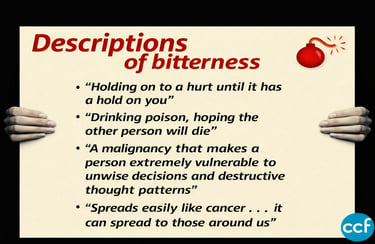
EPHESIANS 4:31 All bitterness, wrath, anger, clamor, and slander must be removed from you, along with all malice.
The instruction is clear: get rid of bitterness. Do not keep a little of it. Do not reserve a small place in your heart for resentment. God does not want us to tolerate bitterness or make excuses for it. We must remove it completely.
This does not mean pretending that we were never hurt or denying that someone did something wrong. It means refusing to allow that offense to control our hearts and dictate how we live.
We cannot always prevent people from hurting us, but with God's grace, we can prevent their actions from turning our hearts into places of bitterness.
Do not allow the roots of bitterness to remain. Remove them before they grow and produce destructive fruit.
That is why Hebrews warns us not to allow a root of bitterness to spring up. When bitterness grows, it causes trouble, and the passage tells us that many can become defiled by it.
In other words, bitterness does not affect only the person who is carrying it. It can affect our spouses, children, family members, friends, fellow believers, and even the people who have nothing to do with the original offense. Bitterness creates collateral damage. One person's unresolved resentment can eventually poison an entire relationship or even a community.
We must understand that bitterness is a dangerous weapon in the hands of our enemy. Satan wants to use our painful experiences to destroy our relationships, weaken our faith, steal our joy, and keep us from experiencing the fullness of God's grace. What begins as an unresolved hurt can become a spiritual stronghold if we continue to entertain it.
That is why we must deal with bitterness at its roots. Do not wait until it becomes deeply established in your heart. Do not give resentment a place to grow. Bring your pain before the Lord and allow His grace to deal with what is happening inside you.
2. Growing Roots of Betterness.
Removing bitterness is only part of the process. We must also make sure that we do not leave room for bitterness to take root again.
It is not enough to remove the negative. We need to cultivate what is positive and pleasing to God.
Instead of allowing anxiety to control our hearts, we should learn to pray and trust God. Instead of allowing unwholesome words to come out of our mouths, we should speak words that encourage, strengthen, and build others up. Instead of dwelling on our painful experiences, we should meditate on God's goodness, faithfulness, and promises.
We need to establish our lives deeply in God so that when difficulties come, our roots will remain firmly planted in Him.
JEREMIAH 17:7 Blessed is the man who trusts in the Lord, And whose trust is the Lord. 8 For he will be like a tree planted by the water That extends its roots by a stream, And does not fear when the heat comes; But its leaves will be green, And it will not be anxious in a year of drought, Nor cease to yield fruit.
Notice that this passage does not say that there will be no heat or drought. The tree will still experience difficult conditions. However, because its roots extend toward the water, it can continue to receive the nourishment it needs.
The same is true in our Christian lives. Trusting God does not mean that we will never experience disappointments, trials, painful circumstances, or difficult relationships. We will still encounter challenges. There will be seasons when life becomes difficult, when people disappoint us, and when circumstances do not turn out the way we expected.
But when our roots are deeply planted in the Lord, we do not have to be controlled by our circumstances. We can remain steady because our confidence is in God, not in the situation around us.
The grace of God gives us the confidence to face difficulties without losing our joy, our faith, or our spiritual stability. We can continue to bear fruit even in seasons of drought because our source of strength is the Lord Himself.
PSALM 1:2 But his delight is in the Law of the Lord, And on His Law he meditates day and night. 3 He will be like a tree planted by streams of water, Which yields its fruit in its season, And its [c]leaf does not wither; And in whatever he does, he prospers.
To develop roots that produce better attitudes, better responses, and better character, we must delight in the Word of God and meditate on it day and night.
To plant our roots by the stream means to continually draw nourishment from God's Word. We meditate on who God is, what He has done, what He has promised, and what He teaches us about living a life that pleases Him.
When God's Word fills our minds and shapes our hearts, it influences how we see our circumstances, how we treat people, and how we respond when we are hurt.
We begin to see our experiences from God's perspective rather than allowing our emotions to determine our responses. We learn to trust His character even when we do not understand His ways.
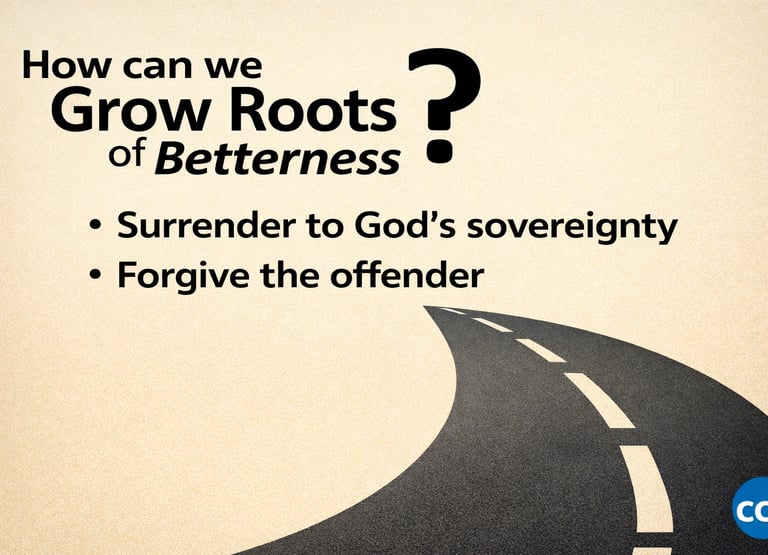
A. Surrender to God's sovereignty.
One of the most important steps in overcoming bitterness is learning to surrender our circumstances to the sovereignty of God.
We must recognize that God is still in control, even when people do wrong things to us. We may not understand why certain things happen, but we can trust that God is able to work even through painful experiences to accomplish His purposes.
In the process, we must also honestly confess before God that we have allowed bitterness to take root in our hearts. We must acknowledge our resentment, anger, and unwillingness to forgive. Confession allows us to stop making excuses and begin dealing with the condition of our hearts.
B. Forgive the offender.
Another important step in growing the roots of betterness is learning to forgive those who have hurt us.
Forgiveness is not always easy, especially when the offense is serious and the pain is deep. Our natural tendency is to hold on to the hurt, demand justice, or wait for the offender to apologize. But God calls us to forgive.
We must understand that forgiveness is not saying that the offender did nothing wrong. It is not excusing the wrongdoing, forgetting what happened, or necessarily restoring the same level of trust and relationship. Forgiveness means releasing our personal resentment and surrendering the matter to God.
We forgive not because the offender deserves it, but because God has shown us mercy and grace.
Forgiveness is also for our own freedom. When we refuse to forgive, we remain emotionally and spiritually tied to the offense. We continue carrying the burden of what someone did to us. But when we forgive, we release that burden into God's hands.
We are not necessarily setting the offender free from accountability; we are allowing God to free our hearts from the bondage of bitterness.
LUKE 23:34 [But Jesus was saying, “Father, forgive them; for they do not know what they are doing.”] And they cast lots, dividing His garments among themselves.
Even while hanging on the cross, experiencing unimaginable suffering, Jesus prayed for the forgiveness of those who were responsible for His crucifixion. While Jesus was suffering, the people continued doing what they wanted to do. They were casting lots for His garments while He was hanging on the cross.
Their actions did not immediately change. They did not suddenly stop their wrongdoing because Jesus prayed for them. Yet Jesus chose to respond with forgiveness rather than bitterness and revenge.
Forgiveness is a decision we make before God. We cannot always control the actions or responses of the people who hurt us. They may never apologize. They may never acknowledge their wrongdoing. They may continue doing what they have been doing. But we can choose to surrender the matter to God and refuse to allow bitterness to control our hearts.
Jesus is our perfect example. He entrusted Himself to the Father and extended forgiveness even in the midst of suffering.
If Jesus could demonstrate such grace toward those who crucified Him, we must also depend on His grace as we learn to forgive those who have hurt us.
GENESIS 50:19 But Joseph said to them, “Do not be afraid, for am I in God’s place? 20 As for you, you meant evil against me, but God meant it for good in order to bring about this present result, to keep many people alive.
Joseph's brothers had treated him terribly. They hated him, plotted against him, sold him into slavery, and caused him years of suffering. He experienced injustice, rejection, separation from his family, and imprisonment.
Yet Joseph did not allow those painful experiences to make him a bitter person.
Notice his understanding of God's sovereignty. He recognized that his brothers intended evil, but God intended to accomplish something good through those same circumstances.
Joseph did not deny the evil that his brothers had done. He clearly acknowledged their wrong intentions. But he also recognized that their evil actions could not defeat God's good purposes.
Joseph understood that God was working behind the scenes, even when he could not see the bigger picture.
People may hurt us intentionally or unintentionally. They may treat us unfairly, disappoint us, or cause us great pain. But we must remember that God is greater than our circumstances and that He is able to bring good out of situations that others intended for evil.
Surrendering to God's sovereignty does not mean approving of what the offender did. It means trusting that God is the righteous Judge and that He is able to accomplish His purposes despite the wrong things people have done to us.
1 PETER 2:23 and while being abusively insulted, He did not insult in return; while suffering, He did not threaten, but kept entrusting Himself to Him who judges righteously;
Jesus experienced humiliation, rejection, injustice, and suffering. People insulted Him, mocked Him, and treated Him cruelly. Yet He did not respond with insults or threats.
Instead, He entrusted Himself to His Father, who judges righteously.
Jesus surrendered Himself to the sovereign will of His loving Heavenly Father. He knew that His Father was in control and that He would judge everything rightly.
This is the example we must follow. When people hurt us, we do not have to retaliate. We do not have to repay evil with evil. We can entrust ourselves to God, knowing that He sees everything and that His judgment is always right.
And Jesus did not only demonstrate trust in His Father; He also demonstrated forgiveness.
PRAYER
Heavenly Father,
Thank You for Your Word that reminds us to remove every root of bitterness and allow our lives to grow in Your grace. Forgive us for the times we have held on to hurts, disappointments, anger, and unforgiveness.
Lord, help us surrender our painful experiences to Your sovereign hands. Give us the wisdom to see things from Your perspective, the grace to forgive those who have hurt us, and the strength to respond with love rather than bitterness.
Teach us to trust You in every circumstance and to remain deeply rooted in Your Word. May our trials develop our character, strengthen our faith, and make us more like Jesus.
Father, help us choose to become better, not bitter. May our words, attitudes, and actions reflect Your goodness and bring glory to Your name.
We commit our hearts and lives to You. In the precious name of Jesus, we pray.
Amen.
The content of this article is adapted from the source below:
Bitterness or Betterness

Get in touch for more insights.
Follow
Subscribe
info@themessageofgod.Some
123-456-7890
© 2025. All rights reserved.
By God’s grace, this website, The Message of God, was created to share His Word, encourage others in their faith, and lead people to a personal relationship with Jesus Christ. God has uniquely designed and equipped every believer to take part in His work, and this website is one small expression of that calling.
All glory, honor, and praise belong to God alone. I am deeply grateful to Christ’s Commission Fellowship (CCF)—God’s instrument in helping me know Jesus personally and grow in a deeper, more intimate relationship with Him. The messages shared here are inspired by past CCF sermons, which have greatly influenced my walk with the Lord.
The ultimate purpose of this website is to point people to Jesus, encourage them to follow Him wholeheartedly, and remind every reader that a life surrendered to Christ is a life filled with purpose, grace, and joy.