
Christmas: God's Sovereign Grace in Action
But when the fullness of the time came, God sent forth His Son, born of a woman, born under the Law,
GALATIANS 4:4
12/22/201312 min read
For the first three centuries, early Christians did not celebrate Christmas. The formal observance emerged only after 300 A.D. When it was introduced, the bishop of Rome designated December 25 as the date, while the bishop of Jerusalem held to January 6. Yet regardless of the date, Christmas remains an extraordinary event. Jesus was a real historical figure, truly born into this world, and His coming was so significant that it reshaped history itself—dividing time into B.C. and A.D. Through His life and teachings, He introduced a radical way of living marked by love, forgiveness, and transformation.
Grace cannot be bought, it cannot be earned, and it cannot be demanded. It is a gift—completely unmerited and freely given. This is sovereign grace: no one ever compelled God to send His Son. Nobody ever forced God to have pity on us. Everything about Christmas was initiated by God Himself. From the sending of Jesus to the salvation He accomplished, it was all the outpouring of God’s boundless love and mercy toward us.
Prayer
Father in heaven,
We come before You with grateful hearts, remembering that everything about our salvation began with You. No one compelled You, no one persuaded You, no one forced You to show mercy—yet You freely gave us Your sovereign grace. Thank You for sending Jesus, not because we deserved Him, but because Your love is greater than our sin and Your compassion deeper than our need.
Lord, we remember the miracle of Christ’s coming, a moment in history so powerful that it reshaped the world. Whether early believers marked the date or not, we celebrate that the eternal Son truly entered time and was born among us. His birth changed history; His life changed hearts. He taught us to love, to forgive, to walk in humility, and to live by the power of Your Spirit.
Thank You, Father, for the precious blood of Christ, by which we were redeemed—not with silver or gold, but with a sacrifice without blemish. Thank You that You dwell in us by Your Spirit, making our bodies Your temple, calling us to glorify You in all we do.
Teach us, Lord, to walk in the fullness of Your Spirit, to grow from spiritual infancy to maturity, and to live not by our own strength but by Your power. Help us to remember that where Your Spirit is, there is freedom, and as we behold Your glory, You transform us from glory to glory.
Father, let the message of Christmas—the message of sovereign grace—shape our daily lives. May we respond to Your gift with worship, obedience, and love. And may Christ be formed in us more and more until the day we see Him face to face.
In Jesus’ name we pray,
Amen.
LUKE 2:1 Now in those days a decree went out from Caesar Augustus, that a census be taken of all the inhabited earth. 2 This was the first census taken while Quirinius was governor of Syria. 3 And everyone was on his way to register for the census, each to his own city.
The title Caesar means “emperor,” and Augustus means “the revered one” or “the great one.” His original name was Gaius Octavius. He was the grand-nephew of Julius Caesar—his mother’s uncle—and later became his adopted son and heir. Augustus rose to become the most powerful ruler of the Roman Empire during the time of Jesus’ birth. When he issued a decree for a census, his intention was political and practical: it was for taxation and administrative control. Yet behind this imperial order, God was working out His sovereign plan. Because of this decree, Joseph and Mary traveled to Bethlehem, fulfilling the prophecy that the Messiah would be born in David’s city.
LUKE 2:4 Joseph also went up from Galilee, from the city of Nazareth, to Judea, to the city of David which is called Bethlehem, because he was of the house and family of David, 5 in order to register along with Mary, who was engaged to him, and was with child.
Joseph traveled from Galilee, from the town of Nazareth, down to Judea—to Bethlehem, the city of David—because he belonged to David’s lineage. He went there to register for the census, and Mary, who was engaged to him and already with child, accompanied him. The journey from Nazareth to Bethlehem was roughly 120 kilometers. Mary was in her ninth month of pregnancy, making the trip extremely difficult.
Joseph and Mary demonstrated hupotassō—submission to authority. They honored the governing laws even when it was inconvenient and burdensome. Traveling such a distance would have taken at least a week on foot or by donkey, over rough terrain, in uncomfortable conditions. Still, they obeyed, trusting God’s plan above their own comfort.
PSALMS 89:3 “I have made a covenant with My chosen; I have sworn to David My servant, 4 I will establish your seed forever And build up your throne to all generations.”
This verse affirms God’s covenant with David—that the Messiah would come from his family line and that his throne would endure through all generations. But when we look at the history of David’s descendants, a serious problem appears. Among his direct royal descendants was King Jehoiakim, a ruler who acted wickedly before God. Because of his sin, God pronounced a judgment on him and his lineage, declaring that none of his descendants would sit on David’s throne or prosper as king.
JEREMIAH 36:30 Therefore thus says the Lord concerning Jehoiakim king of Judah, “He shall have no one to sit on the throne of David …
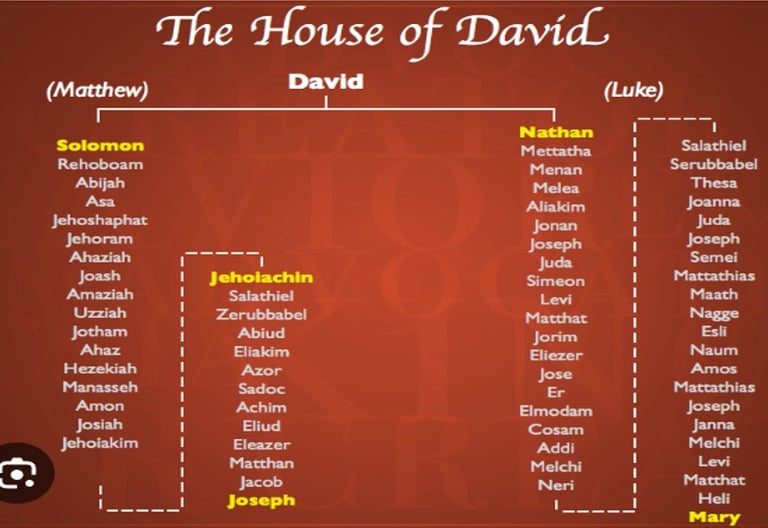
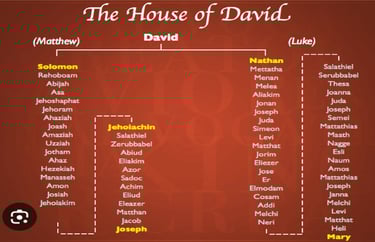
This verse states God’s judgment on Jehoiakim, declaring that none of his descendants would sit on the throne of David. This curse continued through Jehoiakim’s son, Jeconiah, creating a serious problem: the Messiah had to come from David’s line, yet a portion of that royal line was under divine judgment. David, however, had many sons. One branch came through Solomon, the kingly line; the other came through Nathan, another son of David. Matthew’s Gospel traces the genealogy of Jesus through Joseph, following the royal line of Solomon—a line that includes Jeconiah—giving Jesus the legal right to David’s throne, though not biological descent from the cursed king. Luke’s Gospel, on the other hand, traces the genealogy through Mary, following the line of Nathan, a branch free from Jeconiah’s curse, giving Jesus His true physical descent from David. In this way, God preserved the covenant, upheld His judgment, and perfectly fulfilled prophecy through both genealogies.
LUKE 2:6 While they were there, the days were completed for her to give birth. 7 And she gave birth to her firstborn son; and she wrapped Him in cloths, and laid Him in a manger, because there was no room for them in the inn.
Jesus was born in Bethlehem, a very small village of perhaps only 500–800 people. Humanly speaking, nothing about Bethlehem seemed significant, yet God orchestrated events with perfect precision. If Caesar’s decree had come earlier or later, Jesus would have been born in Nazareth. But the order was issued at exactly the right moment, carried across the empire by messengers and horses—yet ultimately governed by God’s sovereign timing. He rules over circumstances, schedules, and even the decisions of rulers. God is seldom early, but He is never late; He acts at the exact time He intends, fulfilling His purposes down to the smallest detail.
MICAH 5:2 But as for you, Bethlehem Ephrathah, Too little to be among the clans of Judah, From you One will go forth for Me to be ruler in Israel. His goings forth are from long ago, From the days of eternity.”
This prophecy reveals two profound truths about the coming King. First, though Bethlehem was small and seemingly insignificant among the clans of Judah, God chose it as the birthplace of the Ruler of Israel. Second, this Ruler would not be an ordinary king—His “goings forth” are from eternity, meaning He has no beginning.
This points to Jesus Christ, the eternal Son of God, who existed even before the world was created. About two thousand years ago, He took on human flesh and was born in Bethlehem, fulfilling God’s promise to send a Messiah. His birth was not the beginning of His existence, but the moment when the eternal King stepped into human history. In humility, He came as a child; in truth, He is the everlasting King of kings, given to us as the promised Messiah.
GALATIANS 4:4 But when the fullness of the time came, God sent forth His Son, born of a woman, born under the Law,
Jesus was born at the exact moment God had prepared. It was the perfect time for the gospel to spread. The ancient world shared a common trade language—Greek, along with Aramaic spoken among the Jews—making communication remarkably unified across regions. At the same time, the Romans had built an extensive and reliable road system, allowing messengers, travelers, and later the apostles to move quickly and safely throughout the empire. Culturally, linguistically, and politically, God had arranged everything so that the message of Christ could travel farther and faster than at any previous moment in history. Truly, Jesus came at the right time—God’s time.
LUKE 2:7 And she gave birth to her firstborn son; and she wrapped Him in cloths, and laid Him in a manger, because there was no room for them in the inn.
If the innkeeper had known that the Child seeking shelter that night was the Son of God—the true “First Family” of heaven—he would have made room without hesitation. But he did not recognize who was arriving at his door. In the same way today, many people still have no room for Jesus in their lives simply because they do not know who He truly is. They crowd their hearts with many things, unaware that the One seeking entrance is the Savior, the King, and the giver of eternal life.
LUKE 2:8 In the same region there were some shepherds staying out in the fields and keeping watch over their flock by night. 9 And an angel of the Lord suddenly stood before them, and the glory of the Lord shone around them; and they were terribly frightened.
This verse tells us that the first announcement of Jesus’ birth was given not to nobles, priests, or influential people, but to shepherds watching their flocks at night. In that culture, shepherds were socially despised and considered outcasts. Their testimony was not accepted in court because they were viewed as liars and thieves—always moving from place to place, often blamed whenever something went missing. They were also religious outcasts. Because of their constant work with animals, they smelled, were considered ceremonially unclean, and could not regularly observe the Sabbath. Yet it was to these very people that God sent His angels with the greatest news the world had ever heard. The grace of God is no respecter of persons; He delights to reveal Himself to the lowly, the overlooked, and the undeserving.
ROMANS 11:5 In the same way then, there has also come to be at the present time a remnant according to God’s gracious choice. 6 But if it is by grace, it is no longer on the basis of works, otherwise grace is no longer grace.
This verse reminds us that God always preserves a remnant by His gracious choice. In Elijah’s day, when the prophet thought he was the only faithful one left, God told him that He had reserved 7,000 people who had not bowed their knees to Baal. It was not human strength or merit that kept them—it was God’s grace. In the same way today, even though the majority in Israel do not believe in Jesus as the Messiah, God still has a remnant there whom He has called to Himself. Their faith, like ours, is not based on works but on the grace of God. Grace means it begins with God, continues by God, and is sustained by God, so that all glory goes to Him alone.
LUKE 2:10 But the angel said to them, “Do not be afraid; for behold, I bring you good news of great joy which will be for all the people; 11 for today in the city of David there has been born for you a Savior, who is Christ the Lord.
This message reveals our deepest need. We do not merely need guidance, comfort, or improvement—we need a Savior. We need forgiveness for our sins and a new life that only God can give. Jesus came precisely to meet that need. No matter what your past looks like, no matter how dark or broken your history may be, Jesus is able to save. Humanly speaking, the apostle Paul seemed like the last person who would ever come to Christ—a persecutor, a violent man, and an enemy of believers. Yet the grace of God reached him, transformed him, and made him an apostle. If Jesus can save Paul, He can save anyone who comes to Him.
1 CORINTHIANS 1:26 For consider your calling, brethren, that there were not many wise according to the flesh, not many mighty, not many noble; 27 but God has chosen the foolish things of the world to shame the wise, and God has chosen the weak things of the world to shame the things which are strong, 28 and the base things of the world and the despised God has chosen, the things that are not, so that He may nullify the things that are, 29 so that no man may boast before God. 30 But by His doing you are in Christ Jesus, who became to us wisdom from God, and righteousness and sanctification, and redemption, 31 so that, just as it is written, “Let him who boasts, boast in the Lord.”
This verse reminds us that God often chooses the weak, the lowly, and the despised to reveal His glory. He did not announce the birth of His Son to the wise, the powerful, or the noble, but to ordinary shepherds—people the world overlooked. This was not an accident; it was God’s design. Christmas is entirely about God’s doing, not ours. The sovereign grace of God is the true meaning of Christmas. It was God’s idea to send His Son. It was God who orchestrated every detail—the timing of Caesar’s decree, the journey to Bethlehem, the humble manger, and the heavenly announcement to shepherds. At the right time and in the right place, God brought His plan of salvation into the world so that no one could boast in themselves, but only in the Lord.
EPHESIANS 1:4 just as He chose us in Him before the foundation of the world, that we would be holy and blameless before Him. In love 5 He predestined us to adoption as sons through Jesus Christ to Himself, according to the kind intention of His will, 11 also we have obtained an inheritance, having been predestined according to His purpose who works all things after the counsel of His will,
This verse teaches us that salvation begins not with us, but with God. Before the foundation of the world, God chose us in Christ and predestined us to be adopted as His sons and daughters. This was His idea, His will, and His loving purpose. No one forced God to save us. No one pressured Him, persuaded Him, or compelled Him to show mercy. Salvation flows entirely from His grace and kindness. He works all things according to the counsel of His will, and our redemption is the result of His eternal plan. Christmas, therefore, is not a story of humanity reaching up to God, but of God reaching down to us—choosing, loving, and saving us according to His sovereign grace.
ACTS 13:48 … and as many as had been appointed to eternal life believed.
Scripture teaches that believing is the result—the consequence—of God’s prior appointment. The appointment here is not to service but to salvation. Not everyone is appointed, but those whom God has chosen will certainly come to faith, and that faith will produce fruit. The fruit does not save us, but it becomes the evidence that God has truly worked in our hearts. Salvation is entirely the work of God—His grace, His calling, His choosing, His power. Our part is to believe, but even that believing is made possible by God’s grace working in us. Left to ourselves, none of us would come; but by His mercy, He enables the heart to trust in Christ. In the end, all glory belongs to God alone for our salvation.
EPHESIANS 2:8 For by grace you have been saved through faith; and that not of yourselves, it is the gift of God; 9 not as a result of works, so that no one may boast.
Even our faith is a gift from God: “For by grace you have been saved through faith; and that not of yourselves, it is the gift of God; not as a result of works, so that no one may boast.” Salvation is entirely God’s work, yet the saddest reality is that many people today receive this greatest gift—a Savior—and do not take it seriously. They have no room for Him in their hearts because they are too busy with the things of the world. True evidence of knowing Jesus is a life marked by joy, peace, and prioritizing Him above all else. Someone who truly knows the Lord will make time for Him, honor Him in their daily choices, and live in gratitude for His incredible gift of grace.
Prayer
Father in heaven,
We praise You for Your sovereign grace and perfect wisdom. Thank You for sending Your Son at the fullness of time—at the right place, at the right moment, according to Your perfect plan. We marvel that You chose to reveal the good news first to humble shepherds, reminding us that Your grace is for the lowly, the broken, and the undeserving.
Thank You that salvation was Your idea, born out of Your love and kindness. Before the foundation of the world, You chose us in Christ, not because of our works or worthiness, but because of Your mercy. No one forced You to save us; You freely gave us Your Son, our Savior, who brings forgiveness, new life, and hope.
Lord, help us to make room for Jesus in our hearts. Open our eyes to see who He truly is—Christ the Lord. Let the message of Christmas lead us to humility, gratitude, and worship. And may our lives reflect Your glory, so that all our boasting will be in You alone.
We thank You for Jesus, our wisdom, righteousness, sanctification, and redemption.
In His precious name we pray.
Amen.
The content of this article is adapted from the source below:
Attributes of God - Christmas: God's Sovereign Grace in Action

Get in touch for more insights.
Follow
Subscribe
info@themessageofgod.Some
123-456-7890
© 2025. All rights reserved.
By God’s grace, this website, The Message of God, was created to share His Word, encourage others in their faith, and lead people to a personal relationship with Jesus Christ. God has uniquely designed and equipped every believer to take part in His work, and this website is one small expression of that calling.
All glory, honor, and praise belong to God alone. I am deeply grateful to Christ’s Commission Fellowship (CCF)—God’s instrument in helping me know Jesus personally and grow in a deeper, more intimate relationship with Him. The messages shared here are inspired by past CCF sermons, which have greatly influenced my walk with the Lord.
The ultimate purpose of this website is to point people to Jesus, encourage them to follow Him wholeheartedly, and remind every reader that a life surrendered to Christ is a life filled with purpose, grace, and joy.