
Endure in Faith
For you have need of endurance, so that when you have done the will of God, you may receive what was promised.
HEBREWS 10:36
8/17/201412 min read
HEBREWS 10:36 For you have need of endurance, so that when you have done the will of God, you may receive what was promised.
Endurance is essential for experiencing God’s promises. This endurance is not passive waiting but an active commitment to continue doing God’s will despite pressure, discouragement, or delay. It addresses the human tendency to give up when life becomes hard, reminding us that quitting prematurely often means missing what God intended to accomplish through the process.
PHILIPPIANS 1:6 For I am confident of this very thing, that He who began a good work in you will perfect it until the day of Christ Jesus.
God Himself is the One who initiates and completes His work in our lives. Spiritual growth is not dependent solely on human effort but on God’s faithfulness working through His Word, His Spirit, other people, life events, and time. This perspective shifts the focus from self-reliance to trust in God’s ongoing work, even when progress seems slow or invisible.
1 Now when Rachel saw that she bore Jacob no children, she became jealous of her sister; and she said to Jacob, “Give me children, or else I die.” 2 Then Jacob’s anger burned against Rachel, and he said, “Am I in the place of God, who has withheld from you the fruit of the womb?” 3 She said, “Here is my maid Bilhah, go in to her that she may bear on my knees, that through her I too may have children.” 4 So she gave him her maid Bilhah as a wife, and Jacob went in to her.
Unmet desires can distort perspective and relationships. Rachel’s desperation exposes a heart that equates fulfillment with a specific blessing, leading her to demand from Jacob something only God can give. Jacob, to his credit, recognizes his limitation, but instead of turning the situation toward God, both of them fall into human reasoning. The decision to use Bilhah reflects impatience and reliance on cultural solutions rather than spiritual dependence. It also shows a failure to learn from past mistakes within the family line, where similar choices had already produced long-term conflict.
5 Bilhah conceived and bore Jacob a son. 6 Then Rachel said, “God has vindicated me, and has indeed heard my voice and has given me a son.” Therefore she named him Dan. 7 Rachel’s maid Bilhah conceived again and bore Jacob a second son. 8 So Rachel said, “With mighty wrestlings I have wrestled with my sister, and I have indeed prevailed.” And she named him Naphtali.
The outcome demonstrates how temporary success can be misinterpreted as divine approval. Rachel attributes meaning to the results in a way that reinforces rivalry rather than humility. Her focus is not on God’s will but on winning against her sister, revealing that even when God allows something to happen, it does not always validate the motives behind it. This reflects how easily people can spiritualize personal ambitions while remaining driven by comparison and competition.
9 When Leah saw that she had stopped bearing, she took her maid Zilpah and gave her to Jacob as a wife. 10 Leah’s maid Zilpah bore Jacob a son. 11 Then Leah said, “How fortunate!” So she named him Gad.12 Leah’s maid Zilpah bore Jacob a second son. 13 Then Leah said, “Happy am I! For women will call me happy.” So she named him Asher.
Leah mirrors Rachel’s actions, showing how unhealthy patterns spread within relationships. Instead of stepping back, she escalates the situation, driven by the same desire for validation and significance. Her interpretation of events centers on external affirmation, indicating that her sense of worth is still tied to how others perceive her. This highlights a deeper issue: when identity is rooted in circumstances or recognition, actions become reactive rather than guided by trust in God.
14 Now in the days of wheat harvest Reuben went and found mandrakes in the field, and brought them to his mother Leah. Then Rachel said to Leah, “Please give me some of your son’s mandrakes.” 15 But she said to her, “Is it a small matter for you to take my husband? And would you take my son’s mandrakes also?” So Rachel said, “Therefore he may lie with you tonight in return for your son’s mandrakes.” 16 When Jacob came in from the field in the evening, then Leah went out to meet him and said, “You must come in to me, for I have surely hired you with my son’s mandrakes.” So he lay with her that night. 17 God gave heed to Leah, and she conceived and bore Jacob a fifth son. 18 Then Leah said, “God has given me my wages (reward) because I gave my maid to my husband.” So she named him Issachar. 19 Leah conceived again and bore a sixth son to Jacob. 20 Then Leah said, “God has endowed me with a good gift; now my husband will dwell with me, because I have borne him six sons.” So she named him Zebulun.
The family dynamic deteriorates further into negotiation and control, reducing relationships to transactions. What should be intimate and meaningful becomes a matter of exchange, exposing how far they have drifted from God’s design. Even though God continues to act within the situation, the participants misunderstand His involvement, interpreting His blessings through the lens of personal gain and human arrangements. This section illustrates how people can involve God in their narrative without truly aligning with His purposes.
22 Then God remembered Rachel, and God gave heed to her and opened her womb. 23 So she conceived and bore a son and said, “God has taken away my reproach.” 24 She named him Joseph, saying, “May the Lord give me another son.”
God directly intervenes in Rachel’s life. Unlike earlier efforts driven by manipulation, this moment emphasizes God’s initiative and timing. Rachel’s response suggests a growing awareness that her situation is ultimately in God’s hands. The change points to a spiritual lesson: what human effort cannot accomplish, God can provide at the right time. It also marks the beginning of a more proper orientation toward prayer and dependence, even if her understanding is still developing.
GENESIS 30:25 Now it came about when Rachel had borne Joseph, that Jacob said to Laban, “Send me away, that I may go to my own place and to my own country. 26 Give me my wives and my children for whom I have served you, and let me depart; for you yourself know my service which I have rendered you.” 27 But Laban said to him, “If now it pleases you, stay with me; I have divined that the Lord has blessed me on your account.” 28 He continued, “Name me your wages, and I will give it.”
Jacob’s request to leave reflects a growing awareness that his season under Laban has reached a turning point. However, what appears to be a simple desire to go home is actually part of a larger process in which God is shaping his understanding of provision and timing. Laban’s response reveals a self-serving motive, recognizing benefit without genuine care, which highlights the imbalance in their relationship. In this moment, Jacob begins to think more strategically, but the deeper lesson is still unfolding—he has not yet fully grasped that blessing ultimately comes from God rather than negotiation.
GENESIS 30:32 let me pass through your entire flock today, removing from there every speckled and spotted sheep and every black one among the lambs and the spotted and speckled among the goats; and such shall be my wages... 43 So the man became exceedingly prosperous, and had large flocks and female and male servants and camels and donkeys.
Jacob’s plan demonstrates human ingenuity mixed with flawed assumptions about control and outcomes. While his approach seems to produce success, the narrative later clarifies that the true cause is not his method but God’s intervention. This tension shows how easy it is to attribute results to personal effort when, in reality, God is working behind the scenes. The resulting prosperity also introduces new relational strain, as success rooted in God’s blessing often exposes the envy and insecurity of others.
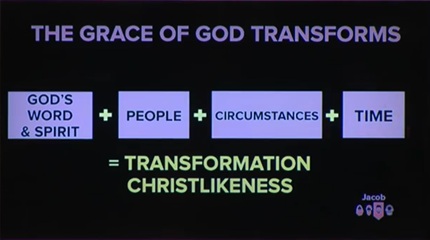
Transformation into Christlikeness is not instant, but the result of God working through multiple channels over time. God uses His Word and Spirit as the foundation—guiding, correcting, and shaping our inner life. At the same time, He places people around us, even difficult ones, to refine our character and expose areas that need growth. He also allows circumstances—both good and painful—to develop our faith, teaching us dependence on Him rather than on ourselves. Finally, time is an essential part of the process, because real spiritual maturity cannot be rushed. When all these work together, God gradually transforms us, not just outwardly, but from the inside out, forming in us a life that reflects Christ.
GENESIS 30
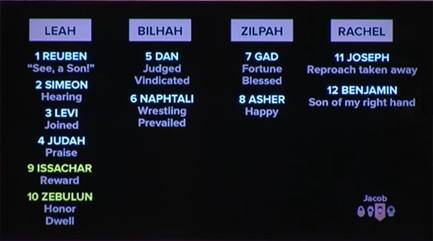
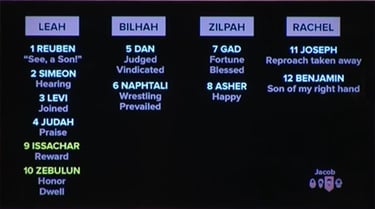
The image traces the names of Jacob’s sons in a way that reveals a deeper spiritual pattern. When their meanings are viewed together, they form a beautiful progression that reflects the message of the gospel—from encountering Christ to eternal glory. This is not accidental; it shows how God was already embedding His redemptive story even within the history recorded in Genesis.
It begins with “behold, a Son,” pointing to the recognition of the One God has given. This moves to “hearing,” which reflects the call to listen and respond to Him. From there comes being “joined,” expressing reconciliation and relationship with the Lord, followed by “praise,” the natural response of a life that has experienced salvation. The sequence then shifts to “judged,” reminding us that sin must be dealt with, and then to “wrestling,” which captures the reality of the Christian life—a continual spiritual struggle where perseverance leads to victory.
As the progression continues, it reveals the outcome of a life aligned with God: it is recognized as “blessed” and marked by true “happiness,” not rooted in circumstances but in God Himself. This leads to the promise of “reward,” pointing forward to eternal life, and then to “honor” and dwelling with God, which is the ultimate fulfillment of every believer’s hope. The journey culminates in God removing all sorrow and establishing His people in His presence, ending with the picture of the Son reigning in authority.
Seen together, this sequence presents a complete spiritual journey—from first encountering Christ to final glorification. It reinforces the truth that from beginning to end, Scripture is centered on Jesus, and even in the lives and names of Jacob’s descendants, God was already revealing the unfolding story of redemption.
Opening Prayer
Heavenly Father,
We come before You with humble hearts, acknowledging that You are the source of all wisdom, strength, and true blessing. Thank You for Your Word that teaches us, corrects us, and leads us into truth. As we begin this time of study, open our minds to understand and our hearts to receive what You want to teach us.
Lord, help us to learn endurance—to keep trusting You even when life is difficult, confusing, or delayed. Guard us from relying on our own understanding or seeking fulfillment in people or circumstances. Teach us to rest in You, to wait patiently, and to follow Your will faithfully.
Use this time to transform us. Shape our character, deepen our faith, and draw us closer to You. May Your Spirit guide us into truth and help us apply what we learn in our daily lives.
We commit this time to You, and we ask that You be honored in all that we do.
In Jesus’ name,
Amen.
4 So Jacob sent and called Rachel and Leah to his flock in the field, 5 and said to them, “I see your father’s attitude, that it is not friendly toward me as formerly, but the God of my father has been with me. 6 You know that I have served your father with all my strength. 7 Yet your father has cheated me and changed my wages ten times; however, God did not allow him to hurt me. 8 If he spoke thus, ‘The speckled shall be your wages,’ then all the flock brought forth speckled; and if he spoke thus, ‘The striped shall be your wages,’ then all the flock brought forth striped. 9 Thus God has taken away your father’s livestock and given them to me...
Jacob begins to reinterpret his experience through a spiritual lens. Instead of focusing on his own strategies, he acknowledges God’s faithfulness in preserving and providing for him despite repeated injustice. This marks a significant shift in his thinking: he starts to see that his life is not controlled by Laban’s actions but by God’s sovereignty. It is the beginning of a more mature faith that recognizes God as the true source of every outcome.
11 Then the angel of God said to me in the dream, ‘Jacob,’ and I said, ‘Here I am.’ 12 He said, ‘Lift up now your eyes and see that all the male goats which are mating are striped, speckled, and mottled; for I have seen all that Laban has been doing to you. 13 I am the God of Bethel, where you anointed a pillar, where you made a vow to Me; now arise, leave this land, and return to the land of your birth.’ ”
God directly reveals His awareness and involvement, confirming that nothing that happened to Jacob was unnoticed. This divine communication redirects Jacob from self-reliance to obedience, reminding him of his earlier commitment and calling him to move forward according to God’s plan. It emphasizes that God’s guidance often comes with both reassurance and instruction, aligning present action with past promises.
27 Why did you flee secretly and deceive me, and did not tell me so that I might have sent you away with joy and with songs, with timbrel and with lyre; 28 and did not allow me to kiss my sons and my daughters? Now you have done foolishly.
31Then Jacob replied to Laban, “Because I was afraid, for I thought that you would take your daughters from me by force.
The tension between Jacob and Laban surfaces openly, exposing underlying fear and mistrust. Jacob’s decision to leave quietly shows that, although his faith has grown, it is still incomplete. Fear continues to influence his actions, illustrating that spiritual growth is gradual. Even as he learns to trust God, he still struggles to act fully in that trust.
29 It is in my power to do you harm, but the God of your father spoke to me last night, saying, ‘Be careful not to speak either good or bad to Jacob.’
God’s protection becomes unmistakably clear. Laban’s acknowledgment that he was restrained by God demonstrates that divine authority overrides human intention. This moment reinforces a crucial truth: God is able to guard His people even when they are vulnerable or unaware of the danger. It deepens Jacob’s understanding that his security does not depend on his own efforts.
GENESIS 31
PSALM 37:7 Rest in the Lord and wait patiently for Him; Do not fret because of him who prospers in his way, Because of the man who carries out wicked schemes.
True endurance involves resting in God and waiting without anxiety. This kind of waiting is not passive resignation but active trust, refusing to be disturbed by the apparent success of wrongdoing. It speaks directly to the temptation to take matters into one’s own hands when circumstances seem unfair.
HEBREWS 10:36 For you have need of endurance, so that when you have done the will of God, you may receive what was promised.
Endurance is defined as continuing in obedience until God’s promise is fulfilled. This connects with Jacob’s journey, showing that perseverance is essential for spiritual formation. The focus is not merely on the outcome but on faithfully doing God’s will over time, trusting that fulfillment will come according to His timing.
GENESIS 31:38 These twenty years I have been with you; your ewes and your female goats have not miscarried, nor have I eaten the rams of your flocks. 39 That which was torn of beasts I did not bring to you; I bore the loss of it myself. You required it of my hand whether stolen by day or stolen by night. 40 Thus I was: by day the heat consumed me and the frost by night, and my sleep fled from my eyes. 41 These twenty years I have been in your house; I served you fourteen years for your two daughters and six years for your flock, and you changed my wages ten times. 42 If the God of my father, the God of Abraham, and the fear of Isaac, had not been for me, surely now you would have sent me away empty-handed. God has seen my affliction and the toil of my hands, so He rendered judgment last night.”
Jacob reflects on his years of service with a new perspective. What once may have seemed like exploitation is now understood as a context in which God demonstrated His justice and provision. His integrity, maintained despite hardship, becomes evidence of transformation. Instead of relying on manipulation, he recognizes God as his defender and provider. This reflection reveals the culmination of a long process: Jacob is no longer defined by his old patterns but is learning to live in dependence on God.
Closing Prayer
Heavenly Father,
Thank You for speaking to us through Your Word. Thank You for reminding us that You are the true source of our blessing, our security, and our joy. We are grateful that even in our struggles and weaknesses, You are at work, shaping us and teaching us to trust You.
Lord, help us to live out what we have learned. Give us the strength to endure in faith, to wait patiently, and to continue doing what is right even when it is hard. Teach us to rely on You and not on our own plans or understanding. When we are tempted to give up, remind us of Your promises and Your faithfulness.
Go with us as we leave this time. Guide our decisions, guard our hearts, and help us reflect Christ in our lives. Continue the work You have begun in us until it is complete.
We give You all the glory, honor, and praise.
In Jesus’ name,
Amen.
The content of this article is adapted from the source below:

Blessed to Bless - Don't Give Up, God is at Work
Get in touch for more insights.
Follow
Subscribe
info@themessageofgod.Some
123-456-7890
© 2025. All rights reserved.
By God’s grace, this website, The Message of God, was created to share His Word, encourage others in their faith, and lead people to a personal relationship with Jesus Christ. God has uniquely designed and equipped every believer to take part in His work, and this website is one small expression of that calling.
All glory, honor, and praise belong to God alone. I am deeply grateful to Christ’s Commission Fellowship (CCF)—God’s instrument in helping me know Jesus personally and grow in a deeper, more intimate relationship with Him. The messages shared here are inspired by past CCF sermons, which have greatly influenced my walk with the Lord.
The ultimate purpose of this website is to point people to Jesus, encourage them to follow Him wholeheartedly, and remind every reader that a life surrendered to Christ is a life filled with purpose, grace, and joy.