
God is El Shaddai
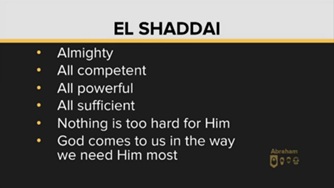
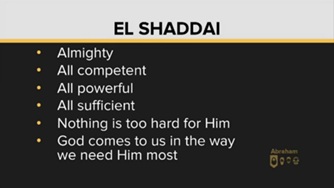
...“I am God Almighty (El-Shaddai);
GENESIS 17:1
5/4/201412 min read
PRAYER
Heavenly Father,
We come before You with humble hearts, acknowledging that You are El Shaddai, the God who is more than enough. Thank You for Your faithfulness, even when we struggle with doubt or try to rely on our own strength. As we reflect on Your Word, teach us to trust in Your promises and not in our own understanding. Help us to wait on You with patience, to walk before You in obedience, and to surrender every part of our lives to Your will. Open our hearts to receive Your truth, and shape us to live by faith in all that we do.
In Jesus’ name,
Amen.
GENESIS 17
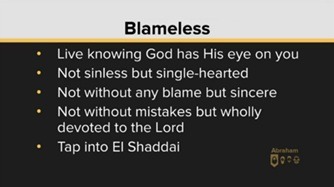
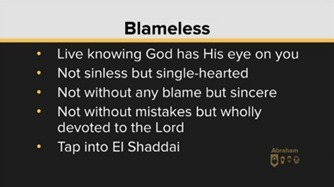
1 Now when Abram was ninety-nine years old, the Lord appeared to Abram and said to him, “I am God Almighty (El-Shaddai); Walk before Me, and be blameless. 2 I will establish My covenant between Me and you, And I will multiply you exceedingly.”
When God reveals Himself as El Shaddai, the emphasis is not only on His power but on His sufficiency during seasons of silence. After many years without hearing from God, Abraham is called to live in continual awareness of God’s presence and to trust that the covenant will be fulfilled by divine ability, not human effort. This moment shows that spiritual maturity is formed in the waiting, where faith is refined and dependence on God deepens.
1 PETER 4:12 Beloved, do not be surprised at the fiery ordeal among you, which comes upon you for your testing, as though something strange were happening to you;
The apostle Peter the Apostle reframes trials as purposeful rather than accidental. Testing is part of the believer’s journey, designed to strengthen faith and align the heart with God’s will. Instead of interpreting difficulties as interruptions, they become instruments through which God shapes endurance and spiritual resilience.
ROMANS 12:1 Therefore I urge you, brothers and sisters, by the mercies of God, to present your bodies as a living and holy sacrifice, acceptable to God, which is your spiritual service of worship.
A life surrendered to God is the natural outcome of understanding His mercy. Walking before God blamelessly is not about perfection through effort but about offering one’s whole life to Him. This surrender becomes an act of worship, where obedience flows from grace rather than obligation.
ISAIAH 40:31 Yet those who wait for the Lord Will gain new strength; They will mount up with wings like eagles, They will run and not get tired, They will walk and not become weary.
The prophet Isaiah presents waiting as an exchange—human weakness is replaced with divine strength. This kind of waiting is active trust, where reliance on God produces endurance and renewed capacity to move forward. It highlights that true strength is not self-generated but received from God in seasons of dependence.
JOHN 15:1 “I am the true vine, and My Father is the vinedresser. 2 Every branch in Me that does not bear fruit, He takes away; and every branch that bears fruit, He prunes it so that it may bear more fruit. 3 You are already clean because of the word which I have spoken to you. 4 Abide in Me, and I in you. As the branch cannot bear fruit of itself unless it abides in the vine, so neither can you unless you abide in Me. 5 I am the vine, you are the branches; he who abides in Me and I in him, he bears much fruit, for apart from Me you can do nothing.
Jesus Christ illustrates a relational dependence using the image of a vine and branches. Fruitfulness is not achieved through striving but through abiding—remaining connected to Him. This reinforces the idea that the ability to live a God-honoring life comes from continual fellowship with Christ, not independent effort.
ISAIAH 30:15 For thus the Lord God, the Holy One of Israel, has said, “In repentance and rest you will be saved, In quietness and trust is your strength.” But you were not willing,
Strength is found in a posture of humility and trust. Rather than striving or resisting, the invitation is to embrace repentance and rest. This reveals that inner stillness before God is a source of spiritual power, though it requires willingness to let go of self-reliance.
MATTHEW 11:28 “Come to Me, all who are weary and heavy-laden, and I will give you rest. 29 Take My yoke upon you and learn from Me, for I am gentle and humble in heart, and you will find rest for your souls. 30 For My yoke is easy and My burden is light.”
Jesus offers a personal invitation to those burdened by life’s demands. Rest is not merely the absence of activity but the presence of Christ carrying what we cannot. To wait on the Lord is to enter into this rest—trusting His timing, submitting to His leadership, and finding peace in His sufficiency.
I. GOD IS GREATER THAN ALL THINGS.
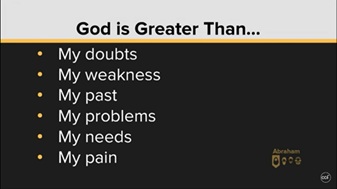
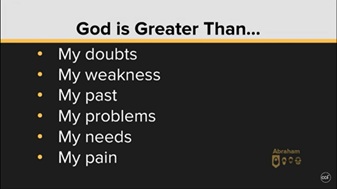
II. GOD IS GREATER THAN MY DOUBTS.
GENESIS 17:3 Abram fell on his face, and God talked with him, saying, 4 “As for Me, behold, My covenant is with you, And you will be the father of a multitude of nations. 5 No longer shall your name be called Abram, But your name shall be Abraham; For I have made you the father of a multitude of nations. 6 I will make you exceedingly fruitful, and I will make nations of you, and kings will come forth from you. 7 I will establish My covenant between Me and you and your descendants after you throughout their generations for an everlasting covenant, to be God to you and to your descendants after you. 8 I will give to you and to your descendants after you, the land of your sojournings, all the land of Canaan, for an everlasting possession; and I will be their God.”
Abraham’s posture of falling before God reflects a heart that recognizes divine authority and responds with humility. In this moment, God not only reiterates His promise but deepens it by redefining Abraham’s identity and future. The change of name signifies transformation—what God declares becomes reality, even before its fulfillment is visible. This passage emphasizes that God’s covenant is initiated and secured by Him alone. It extends beyond one man to future generations and reveals a relationship in which God faithfully commits Himself to His people as their God.
GENESIS 17:9 God said further to Abraham, “Now as for you, you shall keep My covenant, you and your descendants after you throughout their generations. 10 This is My covenant, which you shall keep, between Me and you and your descendants after you: every male among you shall be circumcised.
The focus shifts from God’s promises to human responsibility. While the covenant is established by God, it calls for a response of obedience that reflects trust and submission. The command given introduces a visible and ongoing reminder that this relationship with God is not merely spiritual but meant to shape daily life. It shows that genuine faith expresses itself through willing alignment with God’s will.
GENESIS 17:11 And you shall be circumcised in the flesh of your foreskin, and it shall be the sign of the covenant between Me and you. 12 And every male among you who is eight days old shall be circumcised throughout your generations, a servant who is born in the house or who is bought with money from any foreigner, who is not of your descendants...
Circumcision served as a physical sign that pointed to a deeper spiritual truth—that they belonged to God. It set them apart as His people and wove the covenant into the life of the community across generations. This outward act was never meant to bring salvation, but to testify to a relationship already established by God. It affirmed their identity, their commitment, and their continuity as His covenant people.
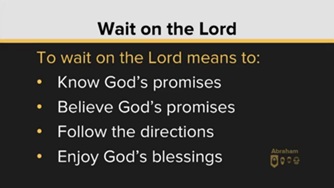
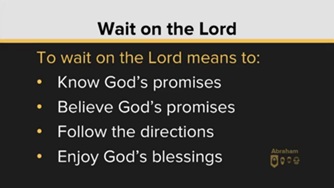
In response, their role was to obey—to move forward in faith, trusting God and waiting with expectation for Him to act. Abraham demonstrated this kind of faith through immediate and complete obedience, showing that true belonging to God is expressed through a willing and responsive heart.
GENESIS 17:23 Then Abraham took Ishmael his son, and all the servants who were born in his house and all who were bought with his money, every male among the men of Abraham’s household, and circumcised the flesh of their foreskin in the very same day, as God had said to him.
Abraham’s immediate obedience demonstrates the proper response to God’s revealed will. There is no delay or negotiation—his actions show that true faith moves promptly and decisively. This highlights that obedience is not about partial compliance but wholehearted trust expressed in action, even when the command may be difficult or deeply personal.
III. GOD IS GREATER THAN MY WEAKNESS.
GENESIS 17:15 Then God said to Abraham, “As for Sarai your wife, you shall not call her name Sarai, but Sarah shall be her name. 16 I will bless her, and indeed I will give you a son by her. Then I will bless her, and she shall be a mother of nations; kings of peoples will come from her.” 17 Then Abraham fell on his face and laughed, and said in his heart, “Will a child be born to a man one hundred years old? And will Sarah, who is ninety years old, bear a child?”
God’s promise shifts specifically to Sarah, showing that His plan does not depend on human ability but on His power. Abraham’s reaction reveals the tension between faith and human reasoning, as he struggles to grasp how such a promise could be fulfilled at their age. This moment highlights that what often limits us is not God’s ability, but our tendency to rely on what seems naturally possible rather than trusting in what God has declared.
GENESIS 18:1 Now the Lord appeared to him by the oaks of Mamre, while he was sitting at the tent door in the heat of the day. 2 When he lifted up his eyes and looked, behold, three men were standing opposite him; and when he saw them, he ran from the tent door to meet them and bowed himself to the earth, 3 and said, “My Lord, if now I have found favor in Your sight, please do not pass Your servant by. 4 Please let a little water be brought and wash your feet, and rest yourselves under the tree; 5 and I will bring a piece of bread, that you may refresh yourselves; after that you may go on, since you have visited your servant.” And they said, “So do, as you have said.” 6 So Abraham hurried into the tent to Sarah, and said, “Quickly, prepare three measures of fine flour, knead it and make bread cakes.” 8 He took curds and milk and the calf which he had prepared, and placed it before them; and he was standing by them under the tree as they ate. 9 Then they said to him, “Where is Sarah your wife?” And he said, “There, in the tent.” 10 He said, “I will surely return to you at this time next year; and behold, Sarah your wife will have a son.” And Sarah was listening at the tent door, which was behind him. 11 Now Abraham and Sarah were old, advanced in age; Sarah was past childbearing. 12 Sarah laughed to herself, saying, “After I have become old, shall I have pleasure, my lord being old also?” 13 And the Lord said to Abraham, “Why did Sarah laugh, saying, ‘Shall I indeed bear a child, when I am so old?’ 14Is anything too difficult for the Lord? At the appointed time I will return to you, at this time next year, and Sarah will have a son.” 15 Sarah denied it however, saying, “I did not laugh”; for she was afraid. And He said, “No, but you did laugh.”
The Lord’s visit to Abraham unfolds in a setting of simple hospitality, yet it carries a profound reminder that God is personally involved in fulfilling His promises. Sarah’s private doubt contrasts with God’s direct question, exposing the human struggle to believe in what seems impossible. The passage teaches that God is fully aware of both our faith and our hidden doubts, and He remains faithful to accomplish His word according to His perfect timing and power.
HEBREWS 11:34 quenched the power of fire, escaped the edge of the sword, from weakness were made strong, became mighty in war, put foreign armies to flight.
Faith is presented as the means by which weakness is transformed into strength. This verse points to a pattern seen throughout Scripture—God does not wait for people to become strong on their own, but works through their limitations to display His power. What appears to be insufficiency becomes the very place where God’s strength is revealed.
2 CORINTIANS 12:9 And He has said to me, “My grace is sufficient for you, for power is perfected in weakness.” Most gladly, therefore, I will rather boast about my weaknesses, so that the power of Christ may dwell in me.
God’s grace is most clearly seen in human weakness. Rather than removing limitations, God often allows them so that dependence on Him increases. This teaches that true strength is not self-produced but comes from relying on Christ, whose power works most effectively in surrendered lives.
HEBREWS 4:15 For we do not have a high priest who cannot sympathize with our weaknesses, but One who has been tempted in all things as we are, yet without sin.
Give your weakness to the Lord. Allow Him to strengthen you and make you able to do what He wants you to do. Jesus Christ is revealed as one who fully understands human weakness. Because He experienced life’s struggles without sin, He is able to respond with compassion and help. This assures believers that bringing their weaknesses to Him is not met with rejection, but with understanding and grace.
ISAIAH 40:31 Yet those who wait for the Lord Will gain new strength; They will mount up with wings like eagles, They will run and not get tired, They will walk and not become weary.
The promise of renewed strength is given to those who choose to wait on the Lord. This waiting is not passive but an active dependence that exchanges human weakness for divine strength. It shows that endurance, perseverance, and spiritual vitality come from trusting God’s timing and relying on His power rather than our own.
IV. GOD IS GREATER THAN MY PAST.
GENESIS 17:17 Then Abraham fell on his face and laughed, and said in his heart, “Will a child be born to a man one hundred years old? And will Sarah, who is ninety years old, bear a child?” 18 And Abraham said to God, “Oh that Ishmael might live before You!” 19 But God said, “No, but Sarah your wife will bear you a son, and you shall call his name Isaac; and I will establish My covenant with him for an everlasting covenant for his descendants after him.
Abraham’s response reveals a mixture of belief and doubt. Instead of fully embracing what God promised, he looks to a solution he had already created and asks God to accept it. This reflects a common human tendency—to trust our own efforts when waiting becomes difficult, and then hope God will approve what we have produced outside His will. Yet God firmly redirects Abraham, making it clear that His plans are not adjusted to fit human shortcuts. What God establishes is rooted in His promise, not in human attempts to fulfill it.
GENESIS 17:20 As for Ishmael, I have heard you; behold, I will bless him, and will make him fruitful and will multiply him exceedingly. He shall become the father of twelve princes, and I will make him a great nation. 21 But My covenant I will establish with Isaac, whom Sarah will bear to you at this season next year.” 22 When He finished talking with him, God went up from Abraham.
God responds with both kindness and clarity. He does not ignore Ishmael, showing that His mercy can extend even to situations born out of human failure. At the same time, He draws a clear distinction between what He permits and what He has purposed. God’s covenant remains aligned with His original promise, demonstrating that while He may bless imperfect circumstances, His redemptive plan is never altered by them. This reveals both His compassion and His sovereignty working together.
ROMANS 5:20 The Law came in so that the transgression would increase; but where sin increased, grace abounded all the more,
Human failure does not limit God’s grace. Where sin and mistakes increase, God’s grace surpasses them, not to justify wrongdoing, but to show the greatness of His mercy. This connects back to Abraham’s story by showing that even when we act in impatience or unbelief, God’s grace is able to restore, redirect, and still accomplish His purposes according to His will.
PRAYER
Heavenly Father,
Thank You for reminding us that Your grace is greater than our failures and that Your plans are never hindered by our weaknesses. Forgive us for the times we have taken matters into our own hands instead of trusting You. Teach us to rest in Your timing and to depend fully on Your strength. Help us to obey You with willing hearts, just as Abraham did, and to trust that You will fulfill every promise in Your perfect way. May we leave this time strengthened, encouraged, and committed to walk with You daily.
In Jesus’ name,
Amen.
The content of this article is adapted from the source below:

Blessed to Bless - Greater Than
Get in touch for more insights.
Follow
Subscribe
info@themessageofgod.Some
123-456-7890
© 2025. All rights reserved.
By God’s grace, this website, The Message of God, was created to share His Word, encourage others in their faith, and lead people to a personal relationship with Jesus Christ. God has uniquely designed and equipped every believer to take part in His work, and this website is one small expression of that calling.
All glory, honor, and praise belong to God alone. I am deeply grateful to Christ’s Commission Fellowship (CCF)—God’s instrument in helping me know Jesus personally and grow in a deeper, more intimate relationship with Him. The messages shared here are inspired by past CCF sermons, which have greatly influenced my walk with the Lord.
The ultimate purpose of this website is to point people to Jesus, encourage them to follow Him wholeheartedly, and remind every reader that a life surrendered to Christ is a life filled with purpose, grace, and joy.