
God is Unchanging
“For I, the LORD, do not change...
MALACHI 3:6
11/10/20139 min read
Semper idem—“always the same”—has been a classic way Christians describe God’s immutability. When people say God is immutable, they’re pointing to something steadying: God doesn’t wake up one day kinder, and the next day harsher. His love, justice, wisdom, and mercy don’t shift with moods, culture, or circumstances.
God’s immutability means He never changes in His being, His character, His purposes, or His promises.
His promises stand firm: What He has spoken, He will perform.
His character is constant: God is forever holy, wise, loving, and just.
His will is steady: His plans are not revised or abandoned because of human failures or changing events.
This doesn’t mean God is static or inactive—He responds, engages, and relates—but He does so consistently with who He has always been.
Prayer:
Lord God,
Thank You for being unchanging and faithful in all Your ways. As I reflect on Your immutability, open my mind to understand what it truly means that You are always the same. Let this truth settle deeply in my heart, so I may trust You without wavering. When my emotions shift, when my circumstances become uncertain, remind me that Your character, Your promises, and Your love never change. Teach me to walk faithfully with You—steady, obedient, and anchored in Your Word. Shape my heart to reflect Your constancy, and help me respond to Your faithfulness with a faithful life of my own. Strengthen me to honor You in every choice, and keep my spirit close to You each day.
In Jesus' name,
Amen.
1. GOD IS UNCHANGING IN HIS PROMISES.
MALACHI 3:6 “For I, the Lord, do not change; therefore you, O sons of Jacob, are not consumed.
This is a moment where God is confronting Israel’s repeated unfaithfulness, yet reminding them why they are still standing: it is because He does not change. When He says, “you, O sons of Jacob, are not consumed,” He is pointing them back to the covenant He made generations earlier with Abraham, Isaac, and Jacob. The people may have wavered, disobeyed, and hardened their hearts, but God remained steady in His promise to preserve Jacob’s descendants. His frustration with their stubbornness is real—He calls out their lack of repentance, their dishonoring of His name, and their failure to worship Him wholeheartedly. Yet even in His rebuke, He anchors them in His faithfulness. They are spared not because they are deserving, but because God’s character does not shift with their behavior. The unchanging God keeps His covenant, and His immutability becomes the very reason His people still experience mercy rather than judgment.
GENESIS 28:14 Your descendants will also be like the dust of the earth, and you will spread out to the west and to the east and to the north and to the south; and in you and in your descendants shall all the families of the earth be blessed. 15 Behold, I am with you and will keep you wherever you go, and will bring you back to this land; for I will not leave you until I have done what I have promised you.”
In this verse, God binds Himself to Jacob with a covenant promise—multiplying his descendants, blessing the nations through them, staying with him wherever he goes, and ultimately fulfilling every word spoken. That promise didn’t end with Jacob; it extended through his whole lineage, the “sons of Jacob.”
GALATIANS 3:29 And if you belong to Christ, then you are Abraham’s descendants, heirs according to promise.
This verse teaches that everyone who belongs to Christ becomes part of the spiritual family of Abraham and a full heir of God’s promise. This doesn’t mean believers become literal, biological descendants of Jacob, but rather that they are included in the same covenant blessing that flowed through Abraham, then to Isaac, then to Jacob, and eventually to Christ. Through Jesus—the true fulfillment of God’s promise to Abraham—all who trust in Him receive the same grace, inheritance, and blessing originally spoken to that family line. In this way, Christians share in the promises God made to Abraham’s descendants, not by bloodline but by faith. So while we are not “sons of Jacob” in an ethnic sense, we stand under the same unchanging faithfulness that preserved Jacob’s family, because in Christ we are grafted into God’s covenant people and made heirs according to promise.
PSALM 145:13 Your kingdom is an everlasting kingdom, and your dominion endures through all generations. The Lord is trustworthy in all he promises and faithful in all he does.
This verse highlights the steady, reliable nature of God’s rule and character. When Scripture says His kingdom is everlasting and His dominion endures through all generations, it’s grounding His promises in His unchanging nature. A God whose reign never ends is a God whose word never collapses. So when we say, “God promises something to us, and because He is unchanging, He will follow through,” we’re simply echoing what David saw so clearly: God’s faithfulness is not tied to our performance or the shifting circumstances around us. His faithfulness flows out of who He is. He doesn’t make promises impulsively or forget them over time. The same God who spoke life, guided His people, fulfilled His covenants, and sent Christ is the God who stands behind every promise He makes today.
MATTHEW 5:37 But let your statement be, ‘Yes, yes’ or ‘No, no’; anything beyond these is of evil.
Jesus calls us to a kind of integrity that mirrors God’s own faithfulness. He’s teaching that our words should be dependable, honest, and free of exaggeration or empty vows. God never speaks carelessly, and He never makes a promise He won’t fulfill. His character is steady, so His word is steady. As His people, we’re called to reflect that same reliability. That means avoiding rash commitments, speaking truthfully, and following through on what we say. It’s better to give a small promise we can keep than a big one we fail to honor. In a world where people often speak loosely or change their minds quickly, living with this kind of integrity becomes a powerful witness to the unchanging God we follow.
2. GOD IS UNCHANGING IN HIS CHARACTER.
JAMES 1:17 Every good thing given and every perfect gift is from above, coming down from the Father of lights, with whom there is no variation or shifting shadow.
James, the brother of Jesus, is writing to Jewish believers who have been scattered because of persecution under Herod Agrippa. They’re frightened, displaced, and facing trials that shake their sense of stability. Into that fear, James reminds them of something they already know: every good and perfect gift they have ever received has come from God—and that same God has not changed simply because their circumstances have.
When he describes God as the “Father of lights, with whom there is no variation or shifting shadow,” James is drawing on the image of the sun, which rises and sets and casts changing shadows. Unlike the heavenly lights that move and shift, God’s character never wavers. The God who was good to them before the persecution is the same God who remains good in the middle of their suffering. His generosity isn’t suspended, His kindness isn’t dimmed, and His faithfulness isn’t altered by hardship. In essence, James is telling them: Your situation may have changed, but your God has not. And remembering that is what steadies the heart in seasons of trial.
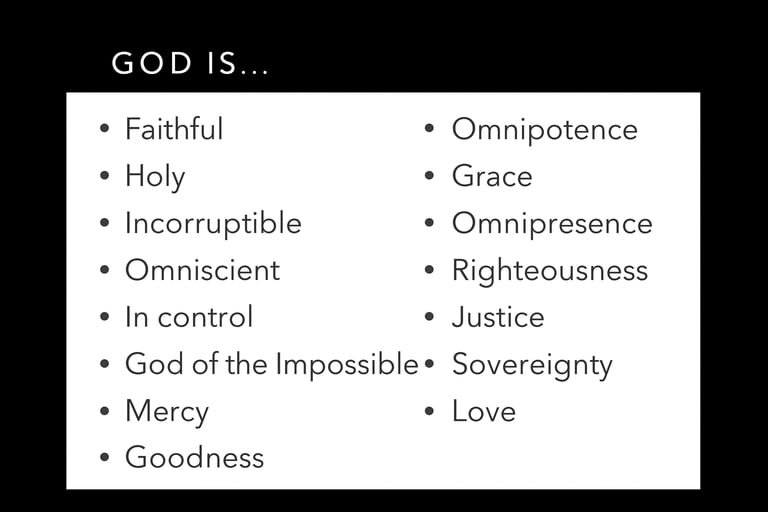
What makes all of these character traits distinctly God’s is the fact that they are Semper Iden, always the same.
3. GOD IS UNCHANGING IN HIS WILL.
1 SAMUEL 15:26 …for you have rejected the word of the Lord, and the Lord has rejected you from being king over Israel.” 27 As Samuel turned to go, Saul seized the edge of his robe, and it tore. 28 So Samuel said to him, “The Lord has torn the kingdom of Israel from you today and has given it to your neighbor, who is better than you. 29 Also the Glory of Israel will not lie or change His mind; for He is not a man that He should change His mind.”
Saul wasn’t rejected because he made a small mistake—he was rejected because he deliberately disobeyed a clear command from God. God told him to devote the Amalekites and all their possessions to destruction as an act of judgment. Instead, Saul selectively obeyed: he spared King Agag, kept the best animals, and then tried to justify it by claiming they were for sacrifice. In doing this, he revealed a heart that feared people more than God, and a will that was no longer aligned with God’s.
When Samuel says, “The Glory of Israel will not lie or change His mind,” he’s reminding Saul that God’s judgment is not like human emotion—unstable, reactive, or reversible. Once God had decreed the kingdom would be taken from Saul and given to another, that purpose was fixed. Not because God is stubborn, but because God’s decisions are always consistent with His own perfect character. If God has purposed something, no amount of pleading or grasping—symbolized by Saul tearing Samuel’s robe—can undo it.
This moment shows God’s immutability in action: His will is firm, His judgment is just, and His purposes are unstoppable. Saul’s partial obedience showed a shifting, unreliable heart; God’s response showed a steady, unchanging righteousness. Even Saul’s desperate attempt to hold on to Samuel portrays the contrast—Saul is unstable, shifting, and fearful, but God’s word stands, unaltered and unalterable.
WE MUST CHANGE: ALIGN WITH GOD'S WILL.
Have a relationship with God.
JOHN 14:6 Jesus *said to him, “I am the way, and the truth, and the life; no one comes to the Father but through Me.
A genuine relationship with God begins with a genuine relationship with Jesus. When Jesus says, “I am the way, and the truth, and the life,” He is not offering a path or a set of ideas—He is offering Himself. He is the way because through His sacrifice and His guidance we are brought into fellowship with the Father. He is the truth because He perfectly reveals who God is and corrects our misunderstandings about Him. He is the life because real spiritual life—peace, purpose, forgiveness, and eternal hope—flows from Him alone. So when a person chooses to know, trust, and follow Jesus, they are not merely becoming religious; they are entering into the very relationship with God that Jesus makes possible. Through Christ, we come to know the Father’s heart, experience His grace, and live in His presence.
We need to align ourselves with God's Law.
HEBREWS 10:31 It is a terrifying thing to fall into the hands of the living God.
This verse isn’t meant to scare us away from God, but to wake us up to the reality that life apart from Him leads to consequences we cannot bear. When the verse says it is “terrifying” to fall into His hands, it highlights that God is not someone we can take lightly—He is living, powerful, and righteous. Because of that, we’re called to examine our lives honestly and bring ourselves into alignment with His ways. Change doesn’t come from fear alone, but from recognizing that God’s commands are not burdens— they are protections and invitations to live rightly. When we surrender our pride, turn from sin, and follow the path God lays out, we don’t fall into His hands for judgment—we fall into His hands for mercy, guidance, and restoration.
We need to say no to good things in order to say yes to great things.
ESTHER 4:14 For if you remain silent at this time, relief and deliverance will arise for the Jews from another place and you and your father’s house will perish. And who knows whether you have not attained royalty for such a time as this?”
Mordecai challenges Esther to see her position not as a personal privilege, but as a divine assignment. She had a comfortable and secure life in the palace—a good life—but God was opening the door to something far greater: becoming His instrument to save an entire nation. The verse reminds us that God’s purposes will move forward with or without us, but when we respond with courage and obedience, we get to participate in the very stories He is writing. Sometimes that means saying “no” to the safe, the familiar, or even the good, so we can say “yes” to the great things God intends. Esther stepped out of comfort and into calling, and because of that, countless lives were preserved. In the same way, when we choose God’s greater purpose over our own convenience, we not only bless others—we also experience the fullness of what God desires to do through us.
Prayer:
Lord God,
Thank You for reminding us that You call us into something deeper than comfort or routine. Just as You placed Esther where she was for a purpose, help us recognize the moments in our own lives when You are inviting us to choose what is great over what is merely good. Give us the discernment to see Your hand at work, the courage to respond with obedience, and the humility to trust that Your plans are always wiser than our own. Guard our hearts from fear and hesitation, and lead us to align our lives with Your will so that others may be blessed through our choices. May we never miss the opportunities You set before us, but instead step forward with faith, knowing that You walk with us and empower us. Use us, Lord, for “such a time as this.”
In Jesus' name,
Amen.
The content of this article is adapted from the source below:
Attributes of God - God is Unchanging, But We Must Change

Get in touch for more insights.
Follow
Subscribe
info@themessageofgod.Some
123-456-7890
© 2025. All rights reserved.
By God’s grace, this website, The Message of God, was created to share His Word, encourage others in their faith, and lead people to a personal relationship with Jesus Christ. God has uniquely designed and equipped every believer to take part in His work, and this website is one small expression of that calling.
All glory, honor, and praise belong to God alone. I am deeply grateful to Christ’s Commission Fellowship (CCF)—God’s instrument in helping me know Jesus personally and grow in a deeper, more intimate relationship with Him. The messages shared here are inspired by past CCF sermons, which have greatly influenced my walk with the Lord.
The ultimate purpose of this website is to point people to Jesus, encourage them to follow Him wholeheartedly, and remind every reader that a life surrendered to Christ is a life filled with purpose, grace, and joy.