
God Is Working Even When He Seems Silent
How long, O Lord? Will You forget me forever? How long will You hide Your face from me?
PSALM 13:1
2/15/201511 min read
The word Exodus means "departure" or "exit." It tells the story of how God brought His people out of slavery in Egypt and led them into freedom. Yet true freedom is more than being released from bondage; it is being set free from what is harmful so that we can worship and serve the Lord. Every person serves something or someone. The worst kind of slavery is not physical bondage but being enslaved to ourselves—our sinful desires, appetites, ambitions, and passions.
PRAYER
Heavenly Father,
Thank You for Your great love and mercy. Thank You for delivering us from the bondage of sin and calling us into the freedom that is found in You. We acknowledge that apart from Your grace, we are slaves to our own desires and unable to live the life You have called us to live.
Lord, help us understand that true freedom is not doing whatever we want, but living according to Your will. Teach us to worship You wholeheartedly, serve You faithfully, and walk in obedience to Your Word. Thank You that You redeem us not only from something but for something—to belong to You and bring glory to Your name.
As You delivered Israel from Egypt, continue to deliver us from every sin, habit, fear, and burden that keeps us from following You completely. Strengthen our faith, deepen our love for You, and help us become all that You created us to be.
May our lives reflect the freedom, joy, and purpose that are found in Christ alone.
In Jesus' name we pray,
Amen.
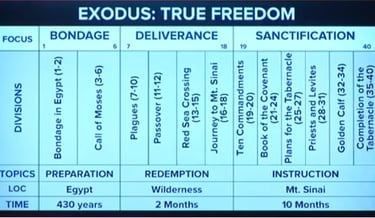
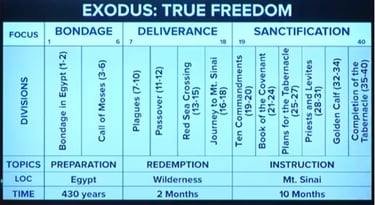
The Book of Exodus is not merely the history of the Jewish people; it is the story of every child of God. It illustrates God's plan to deliver people from the bondage of sin and bring them into a life of true freedom. God's purpose is not simply to rescue us from something but to lead us into something greater—to become all that He created us to be.
Significantly, God did not give the Ten Commandments to Israel until after He had delivered them from Egypt. Redemption came before the Law. In the same way, we cannot truly obey God while we remain slaves to sin. God first sets us free, and then He teaches us how to live as His people. Freedom is therefore not the absence of restraint; it is the ability to live according to God's will.
EXODUS 3:7 The Lord said, “I have surely seen the affliction of My people who are in Egypt, and have given heed to their cry because of their taskmasters, for I am aware of their sufferings. 8 So I have come down to deliver them from the power of the Egyptians, and to bring them up from that land to a good and spacious land, to a land flowing with milk and honey, to the place of the Canaanite and the Hittite and the Amorite and the Perizzite and the Hivite and the Jebusite.
Before Israel ever cried out for deliverance, God was already attentive to their condition. Their rescue did not begin with human strength, strategy, or rebellion; it began with God's compassion. This passage reveals the heart of God toward suffering people. He is neither distant nor indifferent. He sees affliction, hears cries, knows pain, and moves to save. Deliverance is always God's initiative. The goal was not merely to remove Israel from Egypt but to bring them into God's prepared future. In the same way, salvation is not only freedom from sin's bondage but also entrance into the life God intends for His people.
EXODUS 6:6 Say, therefore, to the sons of Israel, ‘I am the Lord, and I will bring you out from under the burdens of the Egyptians, and I will deliver you from their bondage. I will also redeem you with an outstretched arm and with great judgments. 7 Then I will take you for My people, and I will be your God; and you shall know that I am the Lord your God, who brought you out from under the burdens of the Egyptians.
God's promise contains a progression: He would bring them out, deliver them, redeem them, and then claim them as His own people. Freedom was never an end in itself. The purpose of redemption was fellowship with God. This anticipates the gospel, where Christ redeems sinners not merely to improve their circumstances but to restore them to God. Salvation always has a destination—belonging to the Lord and living under His gracious rule.
PSALM 13:1 How long, O Lord? Will You forget me forever? How long will You hide Your face from me?... 5 But I have trusted in Your lovingkindness; My heart shall rejoice in Your salvation. 6 I will sing to the Lord, Because He has dealt bountifully with me.
David's circumstances had not changed, yet his perspective changed because of faith. He moved from lament to confidence without receiving immediate relief. Genuine faith rests in God's character rather than visible evidence. It trusts God's love while waiting for God's timing. This is a powerful reminder that worship is not merely a response to victory; it is also an expression of confidence during the struggle. Faith sees God's future faithfulness as so certain that it responds with gratitude in the present.
EXODUS 1
5 All the persons who came from the loins of Jacob were seventy in number, but Joseph was already in Egypt... 6 Joseph died, and all his brothers and all that generation. 7 But the sons of Israel were fruitful and increased greatly, and multiplied, and became exceedingly mighty, so that the land was filled with them.
Although Joseph and his generation had passed away, God's covenant had not. Human lives are temporary, but God's promises endure. Israel's growth demonstrated that divine purposes do not depend on the survival of one leader or one generation. God was quietly fulfilling what He had promised centuries earlier. Even when God seems silent, He is still at work accomplishing His word.
8 Now a new king arose over Egypt, who did not know Joseph. 9 He said to his people, “Behold, the people of the sons of Israel are more and mightier than we. 10 Come, let us deal wisely with them, or else they will multiply and in the event of war, they will also join themselves to those who hate us, and fight against us and depart from the land.” 11 So they appointed taskmasters over them to afflict them with hard labor. And they built for Pharaoh storage cities, Pithom and Raamses. 12 But the more they afflicted them, the more they multiplied and the more they spread out, so that they were in dread of the sons of Israel.
The new Pharaoh viewed Israel through the lens of fear and self-interest. What God intended for blessing, Pharaoh viewed as a threat. Yet every attempt to suppress God's people only resulted in greater multiplication. Throughout Scripture, human power repeatedly collides with divine purpose and loses. This passage teaches that God's promises are stronger than persecution, and no earthly authority can ultimately stop what God has determined to accomplish.
GENESIS 12:2 And I will make you a great nation… 3 …in you all the families of the earth will be blessed.”
God's covenant with Abraham was never limited to Abraham himself. The promise pointed beyond one man and one nation to the blessing of all peoples. From the beginning, God's plan of redemption had a worldwide scope. Israel existed not merely for its own benefit but as the channel through which God's salvation would eventually reach the nations through Jesus Christ.
GENESIS 17:8 I will give to you and to your descendants… the land…
The promise of descendants and land seemed impossible because Abraham and Sarah lacked the ability to produce an heir. God deliberately chose circumstances that highlighted His power rather than human capability. Divine promises often place people in situations where success becomes impossible apart from God, ensuring that He alone receives the glory when His word is fulfilled.
GENESIS 26:4 I will multiply your descendants… will give your descendants all these lands… by your descendants all the nations of the earth shall be blessed;
The covenant did not end with Abraham. God reaffirmed the same promises to Isaac despite the recurring obstacle of barrenness. This pattern demonstrates that God's faithfulness is not interrupted by human weakness. Obstacles that seem impossible to people are opportunities for God to display His covenant-keeping power.
GENESIS 28:13 …the land on which you lie, I will give it to you… 14 Your descendants will also be like the dust of the earth… in you and in your descendants shall all the families of the earth be blessed.
Jacob received the same covenant promises despite his flaws and failures. God's plan depended on His grace, not human perfection. The repeated promise that all nations would be blessed through Abraham's descendants points forward to Christ, the ultimate fulfillment of God's redemptive purpose. Exodus is therefore part of a much larger story leading to Jesus.
EXODUS 1:13 The Egyptians compelled the sons of Israel to labor rigorously; 14 and they made their lives bitter with hard labor in mortar and bricks and at all kinds of labor in the field, all their labors which they rigorously imposed on them.
Israel's circumstances changed dramatically. Those who once enjoyed privilege became oppressed slaves. The passage reminds believers not to place ultimate confidence in favorable conditions, political status, wealth, or human relationships. All earthly security can disappear. The only unchanging foundation is the faithfulness of God and His promises.
EXODUS 1:15 Then the king of Egypt spoke to the Hebrew midwives, one of whom was named Shiphrah and the other was named Puah; 16 and he said, “When you are helping the Hebrew women to give birth and see them upon the birthstool, if it is a son, then you shall put him to death; but if it is a daughter, then she shall live.” 17 But the midwives feared God, and did not do as the king of Egypt had commanded them, but let the boys live. 18 So the king of Egypt called for the midwives and said to them, “Why have you done this thing, and let the boys live?” 19 The midwives said to Pharaoh, “Because the Hebrew women are not as the Egyptian women; for they are vigorous and give birth before the midwife can get to them.” 20 So God was good to the midwives, and the people multiplied, and became very mighty. 21 Because the midwives feared God, He established households for them.
The Hebrew midwives faced a conflict between obeying earthly authority and obeying God. Their courage flowed from a greater fear—the fear of the Lord. Scripture teaches that government authority is to be respected, but never when it requires disobedience to God. The midwives demonstrate that true faith may require costly courage. God honored them because they valued His authority above all others.
EXODUS 1:22 Then Pharaoh commanded all his people, saying, “Every son who is born you are to cast into the Nile, and every daughter you are to keep alive.”
Pharaoh's escalating cruelty reveals how evil often grows more desperate when confronted with God's purposes. Yet even this dark decree could not prevent God's plan. The worsening situation set the stage for God's greater display of power. Sometimes circumstances deteriorate before God's deliverance becomes visible.
GENESIS 15:13 God said to Abram, “Know for certain that your descendants will be strangers in a land that is not theirs, where they will be enslaved and oppressed four hundred years. 14 But I will also judge the nation whom they will serve, and afterward they will come out with many possessions... 16 Then in the fourth generation they will return here, for the iniquity of the Amorite is not yet complete.”
Long before Israel entered Egypt, God had already revealed the broad outline of their history. Their suffering, deliverance, and eventual return to Canaan were all known to Him. This passage demonstrates both God's sovereignty and His patience. The delay in judgment against the Canaanite nations shows that God gives people opportunity to repent before executing justice. His timing is never arbitrary; it is always righteous and purposeful.
EXODUS 2
1 Now a man from the house of Levi went and married a daughter of Levi. 2 The woman conceived and bore a son; and when she saw that he was beautiful, she hid him for three months.
HEBREWS 11:23 By faith Moses, when he was born, was hidden for three months by his parents, because they saw he was a beautiful child; and they were not afraid of the king’s edict.
Moses' parents did not passively accept the circumstances around them. Faith moved them to protect their son despite enormous risk. Biblical faith is not mere optimism or wishful thinking. It acts in obedience while trusting God with the outcome. Faith does what it can and leaves what it cannot control in God's hands.
EXODUS 2:3 But when she could hide him no longer, she got him a wicker basket and covered it over with tar and pitch. Then she put the child into it and set it among the reeds by the bank of the Nile. 4 His sister stood at a distance to find out what would happen to him. 5 The daughter of Pharaoh came down to bathe at the Nile, with her maidens walking alongside the Nile; and she saw the basket among the reeds and sent her maid, and she brought it to her. 6 When she opened it, she saw the child, and behold, the boy was crying. And she had pity on him and said, “This is one of the Hebrews’ children.” 7 Then his sister said to Pharaoh’s daughter, “Shall I go and call a nurse for you from the Hebrew women that she may nurse the child for you?” 8 Pharaoh’s daughter said to her, “Go ahead.” So the girl went and called the child’s mother. 9 Then Pharaoh’s daughter said to her, “Take this child away and nurse him for me and I will give you your wages.” So the woman took the child and nursed him. 10 The child grew, and she brought him to Pharaoh’s daughter and he became her son. And she named him Moses, and said, “Because I drew him out of the water.”
The preservation of Moses demonstrates the remarkable providence of God. What appeared to be a desperate act became the means by which God positioned His chosen deliverer exactly where he needed to be. Every detail reveals divine orchestration. God used compassion, timing, family relationships, and even Pharaoh's own household to accomplish His purpose. The enemy's plan unintentionally became the pathway for God's deliverer.
ACTS 7:22 Moses was educated in all the learning of the Egyptians, and he was a man of power in words and deeds.
Moses' education in Egypt was not accidental. God was preparing him for future leadership through experiences that may not have seemed spiritual at the time. Often God develops His servants through years of preparation before assigning them their greatest tasks. Seasons of learning, growth, and waiting are frequently part of God's training process.
JOHN 8;34 Jesus answered them, “Truly, truly, I say to you, everyone who commits sin is the slave of sin... 36 So if the Son makes you free, you will be free indeed.
Jesus identifies humanity's deepest bondage—not political oppression but slavery to sin. Sin promises freedom but produces captivity. Christ alone can liberate people from this bondage. The Exodus from Egypt serves as a picture of this greater deliverance. Just as God rescued Israel from Pharaoh, Jesus rescues believers from the dominion of sin. True freedom is not the ability to do whatever we desire; it is the ability to live as God created us to live and worship Him wholeheartedly.
PRAYER
Heavenly Father,
Thank You for Your great love and mercy. Thank You for delivering us from the bondage of sin and calling us into the freedom that is found in You. We acknowledge that apart from Your grace, we are slaves to our own desires and unable to live the life You have called us to live.
Lord, help us understand that true freedom is not doing whatever we want, but living according to Your will. Teach us to worship You wholeheartedly, serve You faithfully, and walk in obedience to Your Word. Thank You that You redeem us not only from something but for something—to belong to You and bring glory to Your name.
Continue to deliver us from every sin, habit, fear, and burden that keeps us from following You completely. Strengthen our faith, deepen our love for You, and help us become all that You created us to be.
May our lives reflect the freedom, joy, and purpose that are found in Christ alone.
In Jesus' name we pray,
Amen.
The content of this article is adapted from the source below:

Exodus - When God Seems Silent, Trust Him
Get in touch for more insights.
Follow
Subscribe
info@themessageofgod.Some
123-456-7890
© 2025. All rights reserved.
By God’s grace, this website, The Message of God, was created to share His Word, encourage others in their faith, and lead people to a personal relationship with Jesus Christ. God has uniquely designed and equipped every believer to take part in His work, and this website is one small expression of that calling.
All glory, honor, and praise belong to God alone. I am deeply grateful to Christ’s Commission Fellowship (CCF)—God’s instrument in helping me know Jesus personally and grow in a deeper, more intimate relationship with Him. The messages shared here are inspired by past CCF sermons, which have greatly influenced my walk with the Lord.
The ultimate purpose of this website is to point people to Jesus, encourage them to follow Him wholeheartedly, and remind every reader that a life surrendered to Christ is a life filled with purpose, grace, and joy.