
God Knows Best
Therefore let him who thinks he stands take heed lest he fall.
1 CORINTHIANS 10:12
3/16/20148 min read
PRAYER
Heavenly Father,
Thank You for reminding us through Your Word that all our labor is truly meaningful only when You are at the center. Forgive us for the times we have sought our own glory or relied on our own strength rather than trusting in Your guidance.
Lord, create in us hearts like David’s—hearts that earnestly seek You, thirst for You, and long for Your presence above all else. Help us to depend on You fully, to align our ambitions with Your will, and to build our lives for Your glory, not our own.
May our efforts bear eternal fruit, rooted in love for You, and may every work we do reflect Your wisdom, purpose, and grace. Fill us with a deep desire for You, so that our lives become true worship, pleasing in Your sight.
In Jesus’ name, we pray,
Amen.
GENESIS 10
1 This is the account of Shem, Ham and Japheth, Noah’s sons, who themselves had sons after the flood... 32 These are the clans of Noah’s sons, according to their lines of descent, within their nations. From these the nations spread out over the earth after the flood.
Chapter 10 presents a broad overview of how the descendants of Noah—through Shem, Ham, and Japheth—formed the nations and spread throughout the earth. It is often called the “Table of Nations” because it lists the families, lands, and languages as they eventually came to be.
Genesis 11 steps back and explains how that dispersion happened. It revisits an earlier moment when humanity was still unified—one people with one language. In their pride, they sought to build the Tower of Babel to make a name for themselves and resist being scattered.
In response, God confused their language, which caused them to stop building and naturally scatter across the earth. This event is the reason behind the division of languages and the spreading of nations described in Genesis 10.
GENESIS 11
1 Now the whole earth used the same language and the same words. 2 It came about as they journeyed east, that they found a plain in the land of Shinar and settled there.
This passage shows a united humanity—but united in disobedience to God. After the flood, God commanded people to fill the earth, yet they chose to settle in Shinar, valuing comfort, security, and unity on their own terms rather than obedience.
3 They said to one another, “Come, let us make bricks and burn them thoroughly.” And they used brick for stone, and they used tar for mortar. 4 They said, “Come, let us build for ourselves a city, and a tower whose top will reach into heaven, and let us make for ourselves a name, otherwise we will be scattered abroad over the face of the whole earth.”
This passage shows a united humanity—but united in disobedience to God. After the flood, God commanded people to fill the earth, yet they chose to settle in Shinar, valuing comfort, security, and unity on their own terms rather than obedience.
Their use of durable, kiln-fired bricks reflects human ability and progress. While innovation itself is not wrong, they used it as a means of pride, seeking to build something that would establish their own greatness apart from God.
Verse 4 reveals their true motive: “Let us build for ourselves… let us make a name for ourselves.”
This is the heart of rebellion—self-exaltation instead of honoring God. They wanted recognition, identity, and security independent of Him. Their fear of being scattered directly opposed God’s command, showing that their unity was rooted in defiance, not faith.
The repeated phrase “let us” highlights their self-centered focus. God is absent from their plans—no acknowledgment, no dependence, no desire to glorify Him.
Though they sought to make a name for themselves, none of their names are remembered. Their pursuit of self-glory failed because it was separated from God.
This passage reminds us that the greatest threat to true worship is pride. Building and achieving are not wrong—but our motive matters. Instead of making a name for ourselves, we are called to honor God and reflect Christ.
Ultimately, the story of Babel is not just about a tower, but about the human heart—how easily we replace God with ourselves.
GENESIS 9:1 And God blessed Noah and his sons and said to them, “Be fruitful and multiply, and fill the earth... 7 As for you, be fruitful and multiply; Populate the earth abundantly and multiply in it.”
In Genesis 9:7, God repeats His command to Noah and his sons to “be fruitful and multiply, and fill the earth.” This repetition is intentional. Within the same moment, God reinforces His instruction to ensure that they clearly understand His will. It emphasizes not only the importance of the command, but also the urgency and responsibility placed upon them to obey. God was making it unmistakably clear: humanity was to spread out and populate the earth abundantly.
PSALM 127:1 Unless the Lord builds the house, the builders labor in vain.
This verse reminds us that no matter how hard we work, our efforts are empty if God is not at the center. Success is not measured by human achievement, but by God’s presence and approval. The people of Shinar labored intensely to build the Tower of Babel, but their work was ultimately in vain because it was driven by pride and independence from God. They wanted to make a name for themselves, yet none of their names are remembered. Their failure shows that when we build for our own glory rather than God’s, our efforts lose their true purpose. The greatest danger is not hard work, but misplaced motives—when self becomes the focus instead of God.
PSALM 63:1 O God, You are my God; I shall seek You earnestly; My soul thirsts for You, my flesh yearns for You, In a dry and weary land where there is no water.
This verse expresses a heart that is fully devoted to God. David describes a deep spiritual hunger—like thirst in a dry and weary land. This is the posture that honors God: not self-exaltation, but dependence and longing for Him. While the people of Babel sought to elevate themselves, David sought God above all else. This teaches us that true fulfillment is not found in building our own name, but in pursuing a relationship with God.
As believers, we are called to continually seek God with that same intensity—to desire Him daily, to depend on Him fully, and to never replace Him with our own ambitions. When our hearts thirst for God, our lives shift from self-centered striving to God-centered worship.
GENESIS 11:5 The Lord came down to see the city and the tower which the sons of men had built. 6 The Lord said, “Behold, they are one people, and they all have the same language. And this is what they began to do, and now nothing which they purpose to do will be impossible for them. 7 Come, let Us go down and there confuse their language, so that they will not understand one another’s speech.” 8 So the Lord scattered them abroad from there over the face of the whole earth; and they stopped building the city.
The builders are called “sons of men,” emphasizing their human limitation in contrast to God’s authority. When it says “the Lord came down,” it uses human language (anthropomorphism) to help us understand God’s intervention—He is personally involved and fully aware of what humanity is doing.
God observes that the people are united with one language, and in their unity, they are capable of accomplishing their self-centered ambitions. However, their unity is not centered on God, but on pride and rebellion. Because of this, God steps in.
The phrase “Let Us go down” reflects the fullness of God’s nature, pointing to the triune God.
GENESIS 11:9 Therefore its name was called Babel, because there the Lord confused the language of the whole earth; and from there the Lord scattered them abroad over the face of the whole earth.
Instead of destroying them, God simply confuses their language. This act is both judgment and mercy—judgment because it stops their rebellion, and mercy because it prevents them from going deeper into sin.
As a result, they can no longer understand one another, the project stops, and they are scattered across the earth—fulfilling God’s original command to spread out. What they resisted, God accomplished.
The name “Babel” means confusion, marking the moment when human pride led to division. This passage reminds us that God sometimes intervenes in our plans—not to harm us, but to redirect us when we are going against His will.
1 CORINTHIANS 10:12 Therefore let him who thinks he stands take heed lest he fall.
If we choose to stand in our own strength, independent of God, we are in a dangerous position. Confidence in self can easily turn into pride, and pride leads to a fall. This verse is a warning against spiritual overconfidence—thinking we are secure when, in reality, we are vulnerable without God.
True stability does not come from trusting ourselves, but from depending on Him. The moment we rely on our own strength instead of God’s grace, we place ourselves at risk of failure. Therefore, we must remain humble, watchful, and fully dependent on God, knowing that apart from Him, we cannot stand.
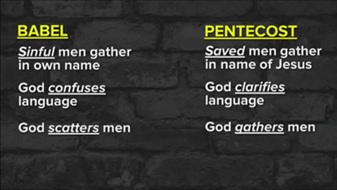
On the day of Pentecost, people from many nations were gathered together as the apostles proclaimed the gospel. When the Holy Spirit came, each person heard the message in their own language.
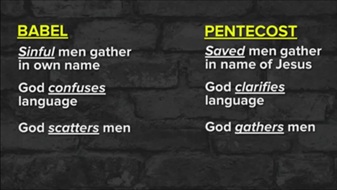
This moment powerfully contrasts with what happened at the Tower of Babel. At Babel, God confused human language because of pride and rebellion, causing division and scattering. But at Pentecost, God worked through different languages to bring understanding and unity in Christ.
In this sense, Pentecost reflects a reversal of Babel—not by removing languages, but by overcoming the barrier they created. Where pride once divided humanity, the gospel now unites people from every nation under God.
ACTS 8:3 But Saul began ravaging the church, entering house after house, and dragging off men and women, he would put them in prison. 4 Therefore, those who had been scattered went about preaching the word.
This verse shows how God can use even persecution to accomplish His purpose. Saul tried to destroy the church, scattering believers by force. Yet what seemed like defeat became God’s strategy—wherever the believers went, they preached the Word. What man intended for harm, God used to spread the gospel. This reflects God’s original desire for His people to go out, not remain comfortable, but bring His truth to the world.
REVELATION 7:9 After these things I saw, and behold, a great multitude, which no man could number, out of every nation and of all tribes and peoples and tongues, standing before the throne and before the Lamb, arrayed in white robes, and palms in their hands; 10 and they cry with a great voice, saying, Salvation unto our God who sitteth on the throne, and unto the Lamb.
We see the final picture: people from every nation, tribe, and language gathered together before God, united in worship. Unlike Babel, where pride caused division, here God brings unity—not by removing diversity, but by redeeming it. All people, though different in language and background, are united in one voice, glorifying God and the Lamb.
PROVERBS 18:10 The name of the Lord is a strong tower; The righteous runs into it and is safe.
The name of the Lord is a strong tower.” While humanity tries to build its own towers for security and identity, true safety is found only in God. Every human “tower” built on pride will fail, but those who run to God will find lasting refuge. This raises a sobering question: what does it profit a person to build a great life, yet lose their soul?
MATTHEW 11:28 “Come to Me, all who are weary and heavy-laden, and I will give you rest.
Jesus calls all who are weary and burdened to come to Him. He offers what no human effort or achievement can give—true rest, forgiveness, and new life. Through His death, our sins are forgiven; through His resurrection, we are given new life.
PRAYER
Heavenly Father,
We thank You for Your Word that reminds us of Your power, wisdom, and love. Lord, even when trials, opposition, or persecution come, help us to trust that You can use every circumstance for Your glory and the spreading of Your truth. May we, like the scattered believers, be bold in sharing the gospel wherever You send us.
Father, unite Your people across every nation, tribe, and tongue. Let our hearts be filled with worship, and may our lives reflect Your salvation to those around us. Teach us to run to You as our strong tower, finding safety, refuge, and hope in Your name alone.
Lord Jesus, we come to You with our burdens, our weariness, and our struggles. Grant us the rest and peace that only You can give. Heal our hearts, renew our spirits, and strengthen us to walk faithfully in Your ways.
We pray this in the mighty and saving name of Jesus. Amen.
The content of this article is adapted from the source below:

Follow God's Design - Trust God: He Knows Best
Get in touch for more insights.
Follow
Subscribe
info@themessageofgod.Some
123-456-7890
© 2025. All rights reserved.
By God’s grace, this website, The Message of God, was created to share His Word, encourage others in their faith, and lead people to a personal relationship with Jesus Christ. God has uniquely designed and equipped every believer to take part in His work, and this website is one small expression of that calling.
All glory, honor, and praise belong to God alone. I am deeply grateful to Christ’s Commission Fellowship (CCF)—God’s instrument in helping me know Jesus personally and grow in a deeper, more intimate relationship with Him. The messages shared here are inspired by past CCF sermons, which have greatly influenced my walk with the Lord.
The ultimate purpose of this website is to point people to Jesus, encourage them to follow Him wholeheartedly, and remind every reader that a life surrendered to Christ is a life filled with purpose, grace, and joy.