
Heed God's Warning
Then God said to Noah, “The end of all flesh has come before Me; for the earth is filled with violence because of them; and behold, I am about to destroy them with the earth.
GENESIS 6:13
3/2/20149 min read
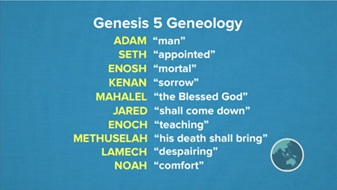
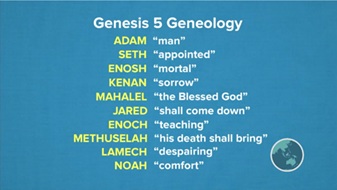
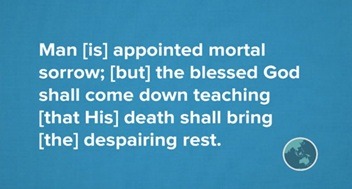
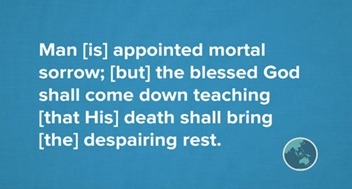
The genealogy in Genesis chapter 5 is more than just a record of names—it carries a deeper message. In the Hebrew language, names often have specific meanings, and when the names in Noah’s lineage are studied together, they form a remarkable prophetic picture. From Adam to Noah, the meanings of these names can be understood as a message pointing to humanity’s condition and God’s plan of redemption. In this way, the genealogy becomes a subtle foreshadowing of Jesus Christ, revealing that even from the earliest chapters of Scripture, God was already unfolding His plan of salvation.
GENESIS 5
GENESIS 6:13 Then God said to Noah, “The end of all flesh has come before Me; for the earth is filled with violence because of them; and behold, I am about to destroy them with the earth.
God declares to Noah that “the end of all flesh has come,” emphasizing that judgment is not impulsive but the result of sustained and widespread violence. Humanity had reached a point where evil was no longer occasional—it had become the dominant pattern of life. This shows that God’s goodness does not mean He overlooks sin. His patience allows time for repentance, but His holiness ensures that sin is ultimately addressed. The warning given to Noah is therefore both justice and mercy: justice for a corrupt world, and mercy in providing a way of salvation through obedience.
GENESIS 6:5 Then the Lord saw that the wickedness of man was great on the earth, and that every intent of the thoughts of his heart was only evil continually. 6 The Lord was sorry that He had made man on the earth, and He was grieved in His heart.
The description of human wickedness—“every intent…only evil continually”—reveals the condition of the human heart, not just outward actions. Sin had penetrated thoughts, desires, and motives. In response, the text says that God “was sorry” and “grieved.” This is not regret in the human sense, as if God made a mistake. Rather, it is relational language that helps us understand His heart. It communicates that God is not distant or indifferent; He is personally affected by the brokenness of His creation.
This grief reflects love, not limitation. The One who knew all things beforehand still chose to create, and therefore also chose to feel the sorrow of a world that turned away from Him. His response is not cold judgment, but a holy and sorrowful justice—one that upholds righteousness while still extending grace, as seen in His instructions to Noah.
PRAYER
Heavenly Father,
You are holy, just, and full of love. Thank You for Your patience, even when we fall short. Help us never to take Your grace lightly or ignore the seriousness of sin. Search our hearts, Lord, and lead us away from what grieves You.
Give us the faith to obey You, just as Noah did, and the humility to walk closely with You each day. Shape our thoughts, our desires, and our actions so that they honor You.
May we live in reverence of Your holiness and in gratitude for Your mercy.
In Jesus’ name,
Amen.
1 Now it came about, when men began to multiply on the face of the land, and daughters were born to them, 2 that the sons of God saw that the daughters of men were beautiful; and they took wives for themselves, whomever they chose. 3 Then the Lord said, “My Spirit shall not strive with man forever, because he also is flesh; nevertheless his days shall be one hundred and twenty years.” 4 The Nephilim were on the earth in those days, and also afterward, when the sons of God came in to the daughters of men, and they bore children to them. Those were the mighty men who were of old, men of renown.
This passage describes a time when humanity multiplied, but so did sin, revealing deep moral corruption. The “sons of God” are understood either as the godly line of Seth or, more consistently with Old Testament usage, as angelic beings who took wives from the “daughters of men,” showing a disregard for God’s order. In response, God declares that His Spirit will not strive with man forever, emphasizing that His patience has a limit, while the “one hundred and twenty years” likely represents a period of grace before judgment. The Nephilim, meaning “fallen ones,” are described as mighty men of renown—figures of great power and influence, sometimes associated with giants (from the Greek gigantes). Ultimately, this passage highlights not just mystery, but the seriousness of human rebellion, setting the stage for God’s righteous judgment while reminding us of both His patience and His holiness.
JUDE 1:6 And angels who did not keep their own domain, but abandoned their proper abode, He has kept in eternal bonds under darkness for the judgment of the great day,
This verse teaches that some angels rebelled against God by leaving their appointed authority and position. As a result, God judged them and bound them in darkness, reserving them for final judgment. It shows that even spiritual beings are accountable to God and that crossing His boundaries leads to certain judgment.
2 PETER 2:4 For if God did not spare angels when they sinned, but cast them into hell and committed them to pits of darkness, reserved for judgment; 5 and did not spare the ancient world, but preserved Noah, a preacher of righteousness, with seven others, when He brought a flood upon the world of the ungodly;
Peter confirms that God did not spare the angels who sinned but cast them into darkness for judgment. He then connects this to the Flood, showing a pattern: God judges sin but preserves the righteous—specifically Noah and his family. This passage highlights both God’s justice and His saving grace.
GENESIS 7:11 In the six hundredth year of Noah’s life, in the second month, on the seventeenth day of the month, on the same day all the fountains of the great deep burst open, and the floodgates of the sky were opened.
This verse describes the beginning of the Flood, where water came from both beneath the earth and above the sky. It emphasizes that the Flood was a massive, divine act of judgment, not merely a natural event. It marked a dramatic turning point in human history due to widespread wickedness.
MATTHEW 24:38 For as in those days before the flood they were eating and drinking, marrying and giving in marriage, until the day that Noah entered the ark, 39 and they did not understand until the flood came and took them all away; so will the coming of the Son of Man be... 42 “Therefore be on the alert, for you do not know which day your Lord is coming.
Jesus affirms the reality of Noah’s time and uses it as a warning. People were living normal lives without awareness of coming judgment until it was too late. In the same way, His return will be unexpected, so believers are called to stay alert and be spiritually prepared.
2 PETER 3:5 For when they maintain this, it escapes their notice that by the word of God the heavens existed long ago… 6 through which the world at that time was destroyed, being flooded with water. 7 But by His word the present heavens and earth are being reserved for fire, kept for the day of judgment and destruction of ungodly men... 11 Since all these things are to be destroyed in this way, what sort of people ought you to be in holy conduct and godliness, 12 looking for and hastening the coming of the day of God…
Peter reminds us that the world was once judged by water and will be judged again, this time by fire. This future reality should shape how we live now. Knowing that judgment is certain, we are called to pursue holy conduct, godliness, and readiness for the day of the Lord.
HEBREWS 11:7 By faith Noah, being warned by God about things not yet seen, in reverence prepared an ark for the salvation of his household, by which he condemned the world, and became an heir of the righteousness which is according to faith.
Noah is presented as an example of true faith. He trusted God’s warning about things he had never seen and responded with obedience by building the ark. His faith was active, not passive—demonstrating that real faith is grounded in God’s word and proven through action.
GENESIS 6
GENESIS 6:8 But Noah found favor in the eyes of the Lord. 9 These are the records of the generations of Noah. Noah was a righteous man, blameless in his time; Noah walked with God... 14 Make for yourself an ark of gopher wood; you shall make the ark with rooms, and shall cover it inside and out with pitch. 15 This is how you shall make it: the length of the ark three hundred cubits, its breadth fifty cubits, and its height thirty cubits... 17 Behold, I, even I am bringing the flood of water upon the earth, to destroy all flesh… 18 …you shall enter the ark—you and your sons and your wife, and your sons’ wives with you. 19 And of every living thing… you shall bring two of every kind… to keep them alive… male and female. 20 …birds after their kind… animals after their kind… will come to you to keep them alive. 21 …take for yourself some of every food that is edible, and gather it to yourself; and it shall be food for you and them.”
Noah found favor in the eyes of the Lord because he was righteous, blameless in his generation, and walked faithfully with God. This does not mean he was perfect—later, he would sin like any human—but it describes the attitude of his heart: a willingness to obey and trust God.
God gave Noah detailed instructions to build the ark: a massive, sturdy vessel made of gopher wood, with rooms, covered inside and out with pitch—a word in Hebrew that also carries the meaning of atonement. The dimensions God provided reflect an extraordinary design: 300 cubits long, 50 cubits wide, and 30 cubits high—the most stable and seaworthy ratio ever discovered, even by modern engineers. Every detail of the ark was divinely appointed, showing God’s care and wisdom.
Noah’s task was to build the ark; bringing the animals was God’s responsibility. This illustrates an important principle: faith is active obedience, but God accomplishes what is beyond human ability. Noah worked on the ark for decades, persevering despite mockery and ridicule from those around him. His faith was steadfast, practical, and demonstrated through action, not just belief.
The ark itself serves as a powerful picture of salvation. Just as the ark preserved Noah and his family from judgment, Christ provides salvation for those who trust and obey Him. Every element—from the wood to the pitch, to the gathering of animals—foreshadows God’s provision and protection for those who rely on Him.
Noah’s life reminds us that God honors hearts that are faithful and obedient, even amid an imperfect world. Obedience, trust, and reverence for God matter more than perfection; what counts is a heart aligned with His will.
1 Then the Lord said to Noah, “Enter the ark, you and all your household, for you alone I have seen to be righteous before Me in this time... 16 Those that entered, male and female of all flesh, entered as God had commanded him; and the Lord closed it behind him.
God was inside the ark inviting Noah, come.
God personally invited Noah to enter the ark: “Come, you and your household, for I have found you righteous in this generation.” The ark represents salvation, and God’s invitation is clear—He alone provides the way of safety. When Noah and his family entered, God Himself closed the door, emphasizing that the timing of salvation is in His hands. Once the door was shut, their security was guaranteed, just as salvation in Christ secures those who trust Him.
The ark has only one door, symbolizing that Jesus is the only way to salvation. No one enters except through God’s provision, and when the time comes, the opportunity will close. Noah was faithful to lead and protect his family, ensuring they were all inside. Though none were perfect, they were safe because of faith and obedience. Like Noah, we are called to respond by faith, bring others with us, and trust God’s protection in the midst of trials and judgment. Salvation is found only through Christ, and it is secured by God Himself.
GENESIS 7
PRAYER
Heavenly Father,
Thank You for the example of Noah, who trusted and obeyed You even when the world mocked him. Help us to walk faithfully with You, keeping our hearts aligned with Your will. Give us the courage to obey Your Word, the patience to persevere, and the faith to trust Your guidance, even when the path is difficult or unclear. May we find favor in Your eyes, not because we are perfect, but because our hearts seek You. Protect us and guide us as You guided Noah, and remind us daily that salvation and hope are found in You alone.
Amen.
The content of this article is adapted from the source below:
Follow God's Design - Heed God's Warning

Get in touch for more insights.
Follow
Subscribe
info@themessageofgod.Some
123-456-7890
© 2025. All rights reserved.
By God’s grace, this website, The Message of God, was created to share His Word, encourage others in their faith, and lead people to a personal relationship with Jesus Christ. God has uniquely designed and equipped every believer to take part in His work, and this website is one small expression of that calling.
All glory, honor, and praise belong to God alone. I am deeply grateful to Christ’s Commission Fellowship (CCF)—God’s instrument in helping me know Jesus personally and grow in a deeper, more intimate relationship with Him. The messages shared here are inspired by past CCF sermons, which have greatly influenced my walk with the Lord.
The ultimate purpose of this website is to point people to Jesus, encourage them to follow Him wholeheartedly, and remind every reader that a life surrendered to Christ is a life filled with purpose, grace, and joy.