
Overcoming Trials
in everything give thanks; for this is God’s will for you in Christ Jesus.
1 THESSALONIANS 5:18
9/11/201110 min read
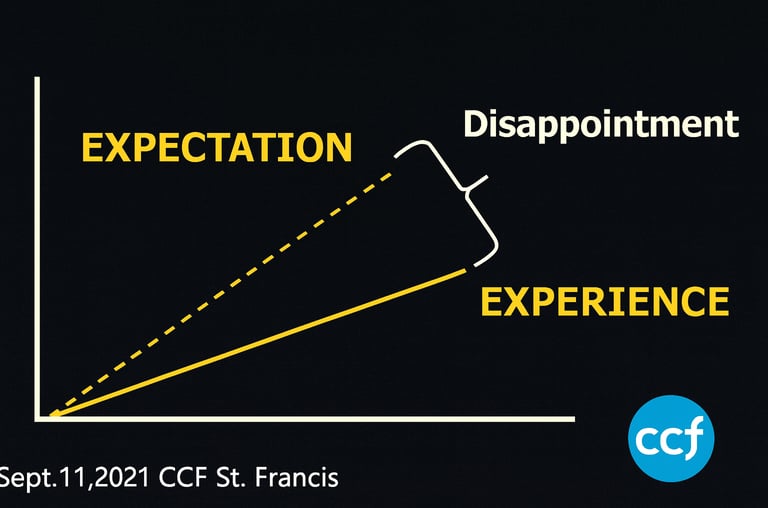

This chart illustrates the relationship between expectation, experience, and disappointment. Expectations often rise faster than reality because they are shaped by our hopes, assumptions, and desires, while real-life experiences tend to progress more slowly and unevenly. When experience fails to meet expectation, a gap is created, and that gap is called disappointment. Disappointment is a normal and unavoidable part of life, but if it is not handled properly, it can lead to negative emotions such as anger, discouragement, and even depression. These emotions can affect our relationships, distort our perspective, and weaken our faith if we allow them to control our responses. Because disappointments are certain in a fallen world, it is important to learn how to deal with them in a healthy way. This means examining our expectations, recognizing that not all of them are aligned with reality or God’s will, and choosing to respond with trust, humility, and dependence on God. When expectations are surrendered to the Lord, disappointment no longer becomes a destructive force but an opportunity for growth, maturity, and deeper faith.
If disappointment is not handled carefully, it can slowly lead to discouragement, and when discouragement is allowed to linger, it can deepen into depression. Discouragement drains a person’s strength and motivation, making it difficult to see purpose or progress. If this state continues unchecked, it can result in depression, which is characterized by a sense of hopelessness and helplessness. Depression is more than temporary sadness; it is a condition marked by intense and prolonged feelings of despair, emptiness, apathy, and loss of hope. When a person reaches this point, life can feel overwhelming and meaningless. This is why it is crucial to recognize and address disappointment early, bringing it to God, seeking truth, support, and renewal before it takes root and grows into something far more damaging.
Prayer
Heavenly Father,
We come before You acknowledging that disappointments are a part of life, and many times our expectations are not met. You see our hearts when we feel hurt, confused, discouraged, or overwhelmed. Lord, we confess that when we are not careful, disappointment can lead us into discouragement, and discouragement can sink us into hopelessness and despair.
Teach us to bring our expectations to You and to trust Your wisdom, timing, and purposes. Guard our hearts from anger, bitterness, and depression. When we feel weak and helpless, remind us that You are near, that You are our refuge and strength, and that our hope is found in You alone.
Renew our minds with Your truth, lift our eyes from our circumstances, and restore our joy in Christ. Help us to lean on You, to seek Your peace, and to walk by faith even when we do not understand. May every disappointment draw us closer to You and shape us to become more like Jesus.
We place our hope in You, Lord, for You are faithful, and Your love never fails.
In Jesus’ name,
Amen.
When you encounter problems and experience disappointment, it is important to pause and ask yourself, “Why am I feeling this way?” This kind of honest self-examination helps you identify the root of what is happening in your heart, not just the surface emotions. Many times, disappointment is a signal that something deeper needs to be addressed—unmet expectations, wrong assumptions, or misplaced hope. Instead of ignoring these feelings or allowing them to control you, you must bring them before God and realign your heart with His truth. Much of our struggle comes from misalignment—when our desires, priorities, or expectations drift away from God’s will. In some cases, depression can be connected to a spiritual issue, such as a loss of trust in God, unresolved sin, or forgetting where our true hope lies. Alignment with God restores clarity, peace, and direction, reminding us that real hope is found not in circumstances, but in Him.
1 THESSALONIANS 5:18 in everything give thanks; for this is God’s will for you in Christ Jesus.
This verse is not a suggestion but a command—gratitude is God’s will for every believer, regardless of circumstances. When we are aligned with God, gratitude flows not from our feelings but from our trust in Him, and it allows us to live in the power of the Holy Spirit. The Christian life was never meant to be lived in our own strength; it is a supernatural life, empowered by God Himself. Disappointment is a normal part of life, and many of the reasons we feel disappointed are real and valid, but disappointment is often not the root problem. The deeper issue is usually misalignment with God—when our hearts, expectations, and focus drift away from Him. Alignment begins when we come to God honestly, ask Him for wisdom, surrender our expectations, and allow His truth to reshape our perspective. In doing so, gratitude replaces despair, and the Holy Spirit restores our peace and hope.
NUMBER 11:10 Now Moses heard the people weeping throughout their families, each man at the doorway of his tent; and the anger of the Lord was kindled greatly, and Moses was displeased. 11 So Moses said to the Lord, “Why have You been so hard on Your servant? And why have I not found favor in Your sight, that You have laid the burden of all this people on me? 12 Was it I who conceived all this people? Was it I who brought them forth, that You should say to me, ‘Carry them in your bosom as a nurse carries a nursing infant, to the land which You swore to their fathers’? 13 Where am I to get meat to give to all this people? For they weep before me, saying, ‘Give us meat that we may eat!’ 14 I alone am not able to carry all this people, because it is too burdensome for me. 15 So if You are going to deal thus with me, please kill me at once, if I have found favor in Your sight, and do not let me see my wretchedness.”
This passage gives us a sobering picture of how unchecked grumbling and unbelief can affect both individuals and leaders. The people of Israel were weeping and complaining about their circumstances, particularly about food, even though God had continually provided for them. Their grumbling was not merely dissatisfaction; it was a sign of unbelief and a failure to trust God’s goodness and provision. This constant complaining created a heavy spiritual atmosphere that deeply affected Moses. Overwhelmed by the burden of leading a grumbling people, Moses became emotionally and spiritually exhausted. His words reveal discouragement and depression so deep that he asked God to take his life. This passage shows how persistent negativity and misalignment with God can drain strength, distort perspective, and lead even faithful servants into despair. It reminds us that when gratitude is replaced by grumbling, faith weakens, joy disappears, and hopelessness can take root. The solution, as Scripture consistently teaches, is not found in changing circumstances but in returning to trust, gratitude, and dependence on God.
Moses' Example
A right view of God is foundational to a healthy and resilient faith. We must continually ask the Lord to give us the faith to believe in His goodness and His faithfulness, especially when circumstances are painful or confusing. When we begin to doubt God’s character—His love, wisdom, or sovereignty—we become misaligned with Him. And when we are not aligned with God, we will struggle to surrender our lives, our expectations, and our future into His hands. Our response to disappointment is deeply shaped by how we see God, and the four common views of God explain why people react so differently to suffering and unmet expectations. Some believe that God cares but is unable; this view may bring temporary emotional comfort, but it ultimately leads to anxiety and insecurity because there is no confidence that God can truly intervene. Others believe that God is able but does not care, which often produces fear, resentment, or bitterness, because God is seen as powerful yet distant or indifferent. A third view is that God is unable and does not care, resulting in despair and hopelessness, leaving a person with no reason to trust or hope at all. The biblical view, however, is that God both cares and is able—He is loving, faithful, and sovereign. This truth anchors the believer’s faith in times of disappointment, assuring us that God is compassionate toward our pain and powerful enough to work through it for His purposes. When we align ourselves with this truth, we find peace, endurance, and hope, even when our circumstances remain unchanged.
NUMBER 11:16 The Lord therefore said to Moses, “Gather for Me seventy men from the elders of Israel, whom you know to be the elders of the people and their officers and bring them to the tent of meeting, and let them take their stand there with you. 17 Then I will come down and speak with you there, and I will take of the Spirit who is upon you, and will put Him upon them; and they shall bear the burden of the people with you, so that you will not bear it all alone.
The Lord did not rebuke Moses for his weakness; instead, He addressed the real problem. Moses was trying to carry the burden of the people alone, and God never intended His servants to function in isolation. God instructed Moses to gather seventy elders and promised to place His Spirit upon them so they could share the responsibility of leadership. This shows that God is deeply concerned about the burdens His people carry and that His solution often involves community rather than isolation. In the same way, God does not intend Christians to live or serve alone. He has given us the church and the family of faith so that we can bear one another’s burdens, receive support, encouragement, and wisdom, and be reminded of His truth when we are weary. Alignment with God includes recognizing our need for others and humbly accepting the help He provides through the body of Christ.
NUMBERS 11:21 But Moses said, “The people, among whom I am, are 600,000 on foot; yet You have said, ‘I will give them meat, so that they may eat for a whole month.’ 22 Should flocks and herds be slaughtered for them, to be sufficient for them? Or should all the fish of the sea be gathered together for them, to be sufficient for them?” 23 The Lord said to Moses, “Is the Lord’s power limited? Now you shall see whether My word will come true for you or not.”
Moses looked at the situation before him and saw an impossible problem. Six hundred thousand people were depending on him, and God had promised to give them meat for an entire month. From a human perspective, it did not add up. Moses began to calculate: flocks, herds, even all the fish of the sea would not be enough.
But Moses was never meant to be the provider. God never intended for Moses to supply what only God could give. God would provide through Moses, not because of Moses. Moses was called to be a channel of God’s blessing, not the source of it. The burden of the people was not Moses’ problem to carry alone—it was God’s responsibility. Moses needed alignment, not more effort.
We cannot fix people. We cannot change hearts. We cannot solve problems that require divine power. Only God can do that. When we take on burdens God never asked us to carry, we become overwhelmed, discouraged, and misaligned with Him.
God’s response to Moses brings everything back into focus: “Is the LORD’s power limited?”
The issue was never the size of the need—it was perspective. Moses was looking at the problem instead of the Provider. God was reminding him that He does not expect His servants to solve impossible problems; He asks them to trust Him.
To align with God, we must surrender:
Surrender to His timetable — trusting that God’s timing is perfect.
Surrender to His purpose — believing His plan is greater than our understanding.
Surrender to His wisdom — choosing faith over human reasoning.
When we surrender, we step into God’s limitless power. He can do what we cannot, and He can change what we are powerless to change. Our role is not to provide, but to trust; not to control, but to align.
The best way to show our faith in God is to align our hearts with gratitude and thanksgiving. We thank Him not because we deserve His love, but because He has freely given it through Jesus Christ. We are forgiven, redeemed, and sustained—not by our strength, but by His grace.
God’s power is not limited. Trust Him. Align with Him. And watch Him work.
MATTHEW 11:28 “Come to Me, all who are weary and heavy-laden, and I will give you rest.
This verse begins with an invitation. God does not command the weary to try harder; He invites them to come. Jesus Himself calls us—not when we are strong, but when we are tired, burdened, and overwhelmed.
True alignment with God begins with alignment through Jesus. We cannot come to the Father in our own strength, wisdom, or effort. Jesus is the way by which we come, the rest by which we remain, and the peace by which we live.
When we are misaligned, we carry burdens we were never meant to bear. When we come to Jesus, we exchange our heavy load for His rest. Rest is not the absence of trouble—it is the presence of Christ.
The invitation still stands: Come.
Come with your weariness.
Come with your burdens.
Come and be aligned through Jesus.
In Him, we find rest for our souls.
Personal Devotional Prayer
Lord God,
I come before You today aware of my weakness and my need for You. I confess how easily my heart drifts from gratitude to grumbling, from faith to doubt. Forgive me for focusing on what I lack instead of remembering all that You have already provided.
Help me to see You rightly, Lord. You are not distant or powerless. You are the God who cares deeply and is able completely. When life feels overwhelming and the burden is heavy, remind me that You never asked me to carry it alone. Teach me to release what I cannot fix and to trust You with what only You can change.
Like Moses, I often look at the size of the need and forget the greatness of Your power. I confess that I try to reason, calculate, and control instead of resting in Your promise. Remind me that I am not the provider—I am only a vessel. What You promise, You will provide.
Today, I choose to surrender. I surrender to Your timing, trusting that You are never late. I surrender to Your purpose, even when I do not understand it. I surrender to Your wisdom, choosing faith over fear.
When I am weary, renew my strength. When I feel alone, remind me that You are with me and that You have placed others around me for support. Realign my heart when I begin to carry burdens that belong to You.
Thank You that Your power is not limited. Turn my eyes from the problem to You, my Provider. Let gratitude replace grumbling, trust replace anxiety, and hope rise in my heart as I rest in You.
Thank You for Your grace given through Jesus Christ. I do not deserve it, yet I receive it with humility and gratitude. I place my life, my concerns, and my future into Your faithful hands.
I trust You, Lord. I surrender to You. I rest in You.
In Jesus’ name,
Amen.
The content of this article is adapted from the source below:
Master Your Emotions Overcoming Discouragement Depression

Get in touch for more insights.
Follow
Subscribe
info@themessageofgod.Some
123-456-7890
© 2025. All rights reserved.
By God’s grace, this website, The Message of God, was created to share His Word, encourage others in their faith, and lead people to a personal relationship with Jesus Christ. God has uniquely designed and equipped every believer to take part in His work, and this website is one small expression of that calling.
All glory, honor, and praise belong to God alone. I am deeply grateful to Christ’s Commission Fellowship (CCF)—God’s instrument in helping me know Jesus personally and grow in a deeper, more intimate relationship with Him. The messages shared here are inspired by past CCF sermons, which have greatly influenced my walk with the Lord.
The ultimate purpose of this website is to point people to Jesus, encourage them to follow Him wholeheartedly, and remind every reader that a life surrendered to Christ is a life filled with purpose, grace, and joy.