
Respond, Don’t React
that there be no immoral or godless person like Esau, who sold his own birthright for a single meal.
HEBREWS 12:16
7/6/20145 min read
Opening Prayer
Heavenly Father,
We come before You with grateful hearts, acknowledging that You are sovereign over our lives. Thank You for Your Word that teaches us, corrects us, and leads us to truth. As we study today, open our hearts and minds to understand Your will. Teach us to respond in faith and not react in impulse. Help us to value what is eternal over what is temporary. Guard our hearts from giving in to wrong desires, and give us the strength to wait on You. May Your Spirit guide us and transform us, so that our lives will honor You in every decision we make.
In Jesus’ name,
Amen.
GENESIS 25:19 Now these are the records of the generations of Isaac, Abraham’s son: Abraham became the father of Isaac; 20 and Isaac was forty years old when he took Rebekah, the daughter of Bethuel the Aramean of Paddan-aram, the sister of Laban the Aramean, to be his wife. 21 Isaac prayed to the Lord on behalf of his wife, because she was barren; and the Lord answered him and Rebekah his wife conceived. 22 But the children struggled together within her; and she said, “If it is so, why then am I this way?” So she went to inquire of the Lord.
The account reveals a powerful contrast between reacting and responding. Instead of taking matters into his own hands when faced with disappointment, Isaac demonstrates a posture of dependence on God through prayer. This shows spiritual maturity—waiting on God rather than forcing a solution. In contrast to Abraham’s earlier failure, Isaac’s choice highlights the importance of surrendering control and trusting God’s timing. It teaches that in seasons of delay and frustration, faith is expressed not through impulsive action, but through patient reliance on the Lord.
HEBREWS 12:16 that there be no immoral or godless person like Esau, who sold his own birthright for a single meal. 17 For you know that even afterwards, when he desired to inherit the blessing, he was rejected, for he found no place for repentance, though he sought for it with tears.
This passage shows the long-term consequences of such decisions. Esau becomes an example of someone who lives without regard for what truly matters, not because he lacks belief, but because he lacks value for spiritual things. His regret comes too late, demonstrating that some consequences cannot simply be undone. This underscores the seriousness of our daily choices—what we consistently prioritize reveals what we truly treasure.
ROMANS 8:28 And we know that God causes all things to work together for good to those who love God, to those who are called according to His purpose.
Despite human failures, God remains faithful to His purposes. For those who belong to Him, even mistakes and difficult circumstances are woven into a greater plan for good. This ties the whole narrative together: while people may falter through impatience, favoritism, or impulsive decisions, God’s redemptive plan continues to unfold. In Christ, believers are given a far greater inheritance than any earthly birthright, reminding us to live with eternity in view rather than being consumed by temporary desires.
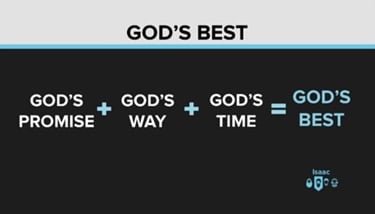
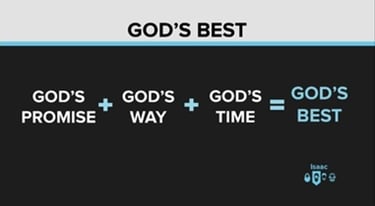
When you are disappointed with life, the natural reaction is to act quickly—fix things, react emotionally, or take control. But that often leads us away from God’s way and God’s timing. That’s why the first step is to PRAY.
Pause — This aligns with trusting God’s timing. Instead of rushing ahead, you acknowledge that God is working, even when you don’t see it.
Resist the first impulse — This is choosing God’s way over your own instincts, which may be driven by fear, frustration, or impatience.
Ask God to control you and what to do — This reconnects you to God’s promise, reminding you that He is faithful and has a purpose.
Yield to God — This is the moment where all three come together: you surrender to His promise, follow His way, and wait for His time.
Disappointment often comes when we want God’s best but skip His process. Prayer re-centers us so we don’t rush ahead or fall behind. It keeps us aligned with the equation—so that instead of settling for less, we experience the fullness of what God intends.
GENESIS 25:23 The Lord said to her, “Two nations are in your womb; And two peoples will be separated from your body; And one people shall be stronger than the other; And the older shall serve the younger.” 24 When her days to be delivered were fulfilled, behold, there were twins in her womb. 25 Now the first came forth red, all over like a hairy garment; and they named him Esau. 26 Afterward his brother came forth with his hand holding on to Esau’s heel, so his name was called Jacob; and Isaac was sixty years old when she gave birth to them.
God’s declaration overturns human expectations and cultural norms, emphasizing His sovereignty over human affairs. The reversal of roles between the older and the younger illustrates that God’s purposes are not bound by tradition or human systems. At the same time, this introduces the tension between divine sovereignty and human responsibility—God is fully in control, yet individuals are accountable for their choices. This passage reminds us that while we faithfully do our part, we must ultimately rest in God’s greater plan, even when it seems paradoxical.
GENESIS 25:27 When the boys grew up, Esau became a skillful hunter, a man of the field, but Jacob was a peaceful man, living in tents. 28 Now Isaac loved Esau, because he had a taste for game, but Rebekah loved Jacob. 29 When Jacob had cooked stew, Esau came in from the field and he was famished; 30 and Esau said to Jacob, “Please let me have a swallow of that red stuff there, for I am famished.” Therefore his name was called Edom.
This passage presents the early formation of character and the seeds of family conflict. The favoritism shown by Isaac and Rebekah creates division, while the differing lifestyles of the brothers reflect deeper spiritual trajectories. This moment also introduces the danger of living for immediate gratification. Esau’s impulsiveness reveals how easily physical needs can overshadow spiritual priorities, while Jacob’s actions show a tendency to manipulate rather than trust. Together, they demonstrate how both unchecked desire and self-reliance can lead to broken relationships and poor decisions.
GENESIS 25:31 But Jacob said, “First sell me your birthright.” 32 Esau said, “Behold, I am about to die; so of what use then is the birthright to me?” 33 And Jacob said, “First swear to me”; so he swore to him, and sold his birthright to Jacob. 34 Then Jacob gave Esau bread and lentil stew; and he ate and drank, and rose and went on his way. Thus Esau despised his birthright.
The value of the birthright is placed against the fleeting satisfaction of a temporary need. This exchange illustrates how spiritual blessings can be disregarded when one is driven by appetite rather than discernment. Esau’s decision reflects a heart that does not fully grasp the weight of what is being lost, while Jacob’s approach shows a willingness to exploit rather than wait on God’s promise. The passage teaches that when desires are not governed by God, they can lead to choices that trade eternal significance for momentary relief.
Closing Prayer
Lord God,
Thank You for reminding us today of the value of our spiritual birthright and the danger of living by impulse. Forgive us for the times we have chosen temporary satisfaction over Your eternal purposes. Teach us to trust You more, to wait patiently, and to seek You first in all things. Strengthen us to manage our desires and to live with wisdom and self-control. Help us to walk in obedience and to treasure the blessings You have given us in Christ. As we go from this place, may we live lives that reflect Your truth and bring glory to Your name.
In Jesus’ name,
Amen.
The content of this article is adapted from the source below:

Blessed to Bless - Respond, Don't React
Get in touch for more insights.
Follow
Subscribe
info@themessageofgod.Some
123-456-7890
© 2025. All rights reserved.
By God’s grace, this website, The Message of God, was created to share His Word, encourage others in their faith, and lead people to a personal relationship with Jesus Christ. God has uniquely designed and equipped every believer to take part in His work, and this website is one small expression of that calling.
All glory, honor, and praise belong to God alone. I am deeply grateful to Christ’s Commission Fellowship (CCF)—God’s instrument in helping me know Jesus personally and grow in a deeper, more intimate relationship with Him. The messages shared here are inspired by past CCF sermons, which have greatly influenced my walk with the Lord.
The ultimate purpose of this website is to point people to Jesus, encourage them to follow Him wholeheartedly, and remind every reader that a life surrendered to Christ is a life filled with purpose, grace, and joy.