
Respond in Meekness
Blessed are the meek, for they shall inherit the earth.
MATTHEW 5:5
7/20/20148 min read
Opening Prayer
Heavenly Father,
We come before You with grateful hearts, acknowledging that You are our God and the source of all truth and wisdom. Thank You for Your Word that teaches us, corrects us, and guides us into a life that honors You. As we study today, open our hearts and minds to understand Your ways. Teach us what it means to respond in meekness—to have strength under Your control. Help us not to react in anger or fear, but to trust You in every situation. Give us discernment to know when to act and when to be still, and shape our character to reflect Christ in all that we do. May Your Holy Spirit lead us and transform us as we listen and learn.
In Jesus’ name,
Amen.
1 CORINTHIANS 10:11 Now these things happened to them as an example, and they were written for our instruction, upon whom the ends of the ages have come.
The events recorded in Scripture are not random stories but intentional lessons designed to guide believers living in the present age. This means the experiences of people in the Old Testament are patterns that reveal how God works and how His people should respond. Since Jesus and the early church relied on these writings, it shows that God’s truth is consistent and unified. Spiritual maturity, therefore, grows as we learn from these examples and allow them to shape how we respond to life, choosing Christ-like responses instead of impulsive reactions.
MATTHEW 5:5 “Blessed are the meek (gentle), for they shall inherit the earth.
Jesus redefines strength by describing meekness as a blessed quality. Meekness is not passivity but controlled power—like strength that is submitted to God’s authority. It reflects a heart that is no longer driven by pride, anger, or self-protection, but by trust in God. This kind of inner control enables a person to respond wisely under pressure, demonstrating that true influence and inheritance come not through force, but through surrender to God’s will.
GENESIS 26
12 Now Isaac sowed in that land and reaped in the same year a hundredfold. And the Lord blessed him, 13 and the man became rich, and continued to grow richer until he became very wealthy; 14 for he had possessions of flocks and herds and a great household, so that the Philistines envied him. 15 Now all the wells which his father’s servants had dug in the days of Abraham his father, the Philistines stopped up by filling them with earth. 16 Then Abimelech said to Isaac, “Go away from us, for you are too powerful for us.”
Isaac’s prosperity becomes a test not just of blessing but of character. His success provokes envy and opposition, showing that blessings can attract conflict. Instead of using his strength to defend his position, Isaac chooses restraint. This reveals that spiritual maturity is seen not in how much power one has, but in how that power is governed. God’s blessing does not remove challenges; rather, it exposes whether a person will trust God or rely on self..
GENESIS 14:14 When Abram heard that his relative had been taken captive, he led out his trained men, born in his house, three hundred and eighteen, and went in pursuit as far as Dan.
Abram demonstrates that faith does not eliminate strength or action. When his relative was taken captive, he decisively mobilized his trained men and pursued the enemy. This was not a reckless reaction but a purposeful response aligned with God’s will. Abram’s action shows that there are moments when obedience to God requires courage, initiative, and even confrontation. His strength was not self-driven but God-directed.
Isaac had the same capacity for strength—he inherited resources, influence, and the ability to defend himself. Yet, unlike Abram, Isaac chose not to fight. The difference was not in their ability, but in God’s direction for each situation. Abram was led to engage, while Isaac was led to yield. Both responses required the same foundation: submission to God.
This is where meekness becomes clear. Meekness is not the absence of power but the discipline to use—or restrain—it according to God’s will. Isaac’s refusal to retaliate was not weakness or fear; it was controlled strength. He did not react emotionally to provocation but responded spiritually with trust in God’s bigger plan.
GENESIS 26:17 And Isaac departed from there and camped in the valley of Gerar, and settled there. 18 Then Isaac dug again the wells of water which had been dug in the days of his father Abraham, for the Philistines had stopped them up after the death of Abraham; and he gave them the same names which his father had given them. 19 But when Isaac’s servants dug in the valley and found there a well of flowing water, 20 the herdsmen of Gerar quarreled with the herdsmen of Isaac, saying, “The water is ours!” So he named the well Esek, because they contended with him. 21 Then they dug another well, and they quarreled over it too, so he named it Sitnah. 22 He moved away from there and dug another well, and they did not quarrel over it; so he named it Rehoboth, for he said, “At last the Lord has made room for us, and we will be fruitful in the land.”
Isaac’s repeated decision to move away from conflict demonstrates a deliberate trust in God’s provision. Rather than clinging to what he could claim as his right, he yields and continues forward. This shows that meekness involves seeing beyond immediate loss and recognizing that God’s plan is larger than any single opportunity. By refusing to fight for temporary security, Isaac positions himself to receive lasting provision, proving that peace and fruitfulness come from trusting God’s direction rather than forcing outcomes.
GENESIS 26:23 Then he went up from there to Beersheba. 24 The Lord appeared to him the same night and said, “I am the God of your father Abraham; Do not fear, for I am with you. I will bless you, and multiply your descendants, For the sake of My servant Abraham.”
God’s appearance to Isaac confirms that every difficulty was part of a divine redirection. Isaac’s journey was not about land or resources, but about being aligned with God’s promises. This teaches that God sometimes allows discomfort to move His people to the place where He wants them to be. True blessing is not tied to location or circumstances but to God’s presence. When the focus remains on Him, fear is replaced with assurance because His promises define the future.
ROMANS 10:17 So faith comes from hearing, and hearing by the word of Christ.
Faith is grounded in God’s revealed word, not in human opinion or emotional experience. This emphasizes that the object of faith must always be God Himself and what He has spoken. When people shift their trust toward individuals instead of Scripture, they risk being misled. Genuine faith grows through consistent exposure to God’s truth, producing obedience that reflects trust in His authority.
DEUTERONOMY 18:20 But the prophet who speaks a word presumptuously in My name which I have not commanded him to speak,… that prophet shall die.’ 21 You may say in your heart, ‘How will we know the word which the Lord has not spoken?’ 22 When a prophet speaks in the name of the Lord, if the thing does not come about or come true, that is the thing which the Lord has not spoken. The prophet has spoken it presumptuously; you shall not be afraid of him.
God provides a clear standard for discerning truth from falsehood. This passage highlights God’s perfection—what He declares will always come to pass. It calls believers to be discerning and grounded in Scripture rather than blindly following voices that claim authority. Spiritual maturity includes the responsibility to test what is heard against God’s Word, ensuring that faith remains anchored in truth.
GENESIS 26:25 So he built an altar there and called upon the name of the Lord, and pitched his tent there; and there Isaac’s servants dug a well.
Isaac’s response to God’s presence is worship, dependence, and continued diligence. Building an altar signifies prioritizing relationship with God above all else. This moment shows that intimacy with God is the foundation of a life that responds in meekness. When a person is aligned with God, their actions flow from trust rather than fear, and their decisions reflect a settled confidence in Him.
GENESIS 26:26 Then Abimelech came to him from Gerar with his adviser Ahuzzath and Phicol the commander of his army. 27 Isaac said to them, “Why have you come to me, since you hate me and have sent me away from you?” 28 They said, “We see plainly that the Lord has been with you; so we said, ‘Let there now be an oath between us, even between you and us, and let us make a covenant with you, 29 that you will do us no harm, just as we have not touched you and have done to you nothing but good and have sent you away in peace. You are now the blessed of the Lord.’ ”... 32 Now it came about on the same day, that Isaac’s servants came in and told him about the well which they had dug, and said to him, “We have found water.”
The transformation in how others view Isaac demonstrates the impact of a life lived in quiet trust. Those who once opposed him recognize God’s presence in his life. This shows that responding in meekness becomes a powerful testimony. Without striving for recognition, Isaac’s consistent trust in God becomes visible, influencing even those who do not share his faith.
MATTHEW 11:28 “Come to Me, all who are weary and heavy-laden, and I will give you rest. 29 Take My yoke upon you and learn from Me, for I am gentle (meek) and humble in heart, and you will find rest for your souls.
Jesus invites believers into a life of rest through submission to Him. Meekness is learned by walking closely with Christ, whose life perfectly models gentle strength. This rest is not the absence of problems but the presence of inner peace that comes from trusting God fully. When a person is yoked with Christ, their responses are shaped by His character, resulting in a life that is calm, steady, and anchored in God.
ISAIAH 55:8 “For My thoughts are not your thoughts, Nor are your ways My ways,” declares the Lord. 9 “For as the heavens are higher than the earth, So are My ways higher than your ways And My thoughts than your thoughts.
God reminds His people that His perspective is far beyond human understanding. This truth explains why meekness is necessary—because without it, people will resist God’s ways when they do not make sense. Trusting in God’s higher wisdom allows believers to accept circumstances that seem unfavorable, knowing that His purposes are always greater than immediate outcomes.
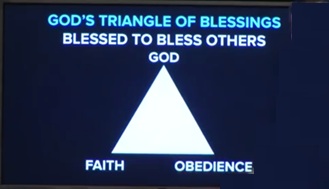
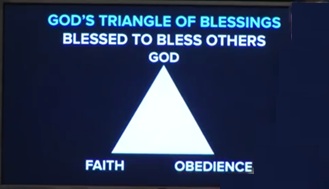
Faith is not self-generated but formed through hearing God’s Word. This connects clearly to the image of the triangle: God is at the top, while faith and obedience form the foundation. True faith begins with God—who He is and what He has said—not with our feelings, circumstances, or human opinions. As we consistently receive His Word, our faith grows, and that faith naturally produces obedience. In the triangle, faith is not the end goal; it is the pathway that leads to obedience, and both are anchored in God at the center.
When the triangle is properly aligned—God first, faith growing from His Word, and obedience following—our lives become stable, purposeful, and a channel of blessing to others.
Closing Prayer
Lord,
Thank You for speaking to us through Your Word today. We are grateful for the example of faith and meekness that You have shown us. Help us to carry these truths into our daily lives—that we may respond with wisdom, patience, and trust in You. Teach us to rely not on our own understanding, but on Your perfect will. Strengthen us to obey You, whether You call us to act or to wait. May our lives be a testimony of Your presence, so that others may see You in us. Keep our hearts centered on You, and remind us that true blessing is found in knowing You. We surrender everything to You, trusting in Your plans and purposes.
In Jesus’ name,
Amen.
The content of this article is adapted from the source below:

Blessed to Bless - Do Not React, Respond in Meekness
Get in touch for more insights.
Follow
Subscribe
info@themessageofgod.Some
123-456-7890
© 2025. All rights reserved.
By God’s grace, this website, The Message of God, was created to share His Word, encourage others in their faith, and lead people to a personal relationship with Jesus Christ. God has uniquely designed and equipped every believer to take part in His work, and this website is one small expression of that calling.
All glory, honor, and praise belong to God alone. I am deeply grateful to Christ’s Commission Fellowship (CCF)—God’s instrument in helping me know Jesus personally and grow in a deeper, more intimate relationship with Him. The messages shared here are inspired by past CCF sermons, which have greatly influenced my walk with the Lord.
The ultimate purpose of this website is to point people to Jesus, encourage them to follow Him wholeheartedly, and remind every reader that a life surrendered to Christ is a life filled with purpose, grace, and joy.