
Spirit Filled Christian
And do not get drunk with wine, for that is dissipation, but be filled with the Spirit,
EPHESIANS 5:18
3/10/201311 min read
In the Christian life, we are not meant to remain in our comfort zones, anchored safely at the shore. God calls us to go out to sea—to venture toward horizons we have never explored. A sailboat does not create the wind; it only responds to it. To harness the power of the wind, the sailor must hoist the sail.
In the same way, we do not manufacture spiritual power. The Holy Spirit is already present, ready to move us forward. Our responsibility is to “hoist the sail”—to live in surrender, faith, and obedience. Sadly, many Christians attempt to live the Christian life in their own strength. As a result, they grow weary, discouraged, and defeated. Victory comes not from striving harder, but from yielding fully to the power of the Spirit who carries us where God intends us to go.
Prayer
Heavenly Father,
We thank You that You have not called us to live a safe and shallow faith, but to step out in trust and follow You beyond our comfort zones. Forgive us for the times we have tried to live the Christian life in our own strength, relying on our efforts instead of Your power.
Teach us to hoist the sail of our hearts—to surrender fully, to obey quickly, and to trust completely. We acknowledge that we cannot create the wind; only Your Holy Spirit gives life, direction, and strength. Move us, Lord, where You desire us to go.
Carry us beyond fear, beyond weariness, and beyond defeat. Lead us into deeper faith, greater obedience, and a life that brings glory to Your name. May we learn to yield daily to the Spirit, allowing Your power to work in and through us.
We set our sails before You today, trusting that You are faithful to guide us into the horizons You have prepared.
In Jesus’ name,
Amen
EPHESIANS 5:18 And do not get drunk with wine, for that is dissipation, but be filled with the Spirit,
Scripture does not say that drinking itself is a sin; the warning is against drunkenness—being mastered or dominated by it. Paul’s deeper concern is not merely alcohol, but control. Just as wine can influence and govern a person’s behavior, God calls believers to be governed by the Holy Spirit.
This is not a suggestion; it is a command. “Be filled” means to be continually under the Spirit’s influence. God gives this command not to limit our freedom, but to protect us and lead us into a life of joy, power, and holiness. His commandments are always for our good—never to restrict us, but to shape us into the people He created us to be.
By grace, God comes into our hearts, and by the same grace He fills us with His Spirit. Grace means receiving what we do not deserve—God’s life, presence, and power freely given to us.
The indwelling of the Holy Spirit happens the moment a person comes to Jesus in repentance and faith. When we surrender our lives to Christ, God gives us His Spirit to dwell within us permanently. This is His gracious gift at salvation.
The filling of the Spirit is closely related, yet often experienced differently. While every believer is indwelt by the Spirit at salvation, many come to experience His fullness later as a deeper and ongoing work. This fullness comes as we continually surrender every area of our lives to Him.
When God indwells us, He begins the work of transformation and gives us new life and power. But when we live in the fullness of the Spirit, we are empowered to walk in holiness. This is sanctification—the outworking of salvation in our daily lives. Salvation and sanctification belong together: salvation is the foundation, and sanctification is the lifelong process of becoming more like Christ.
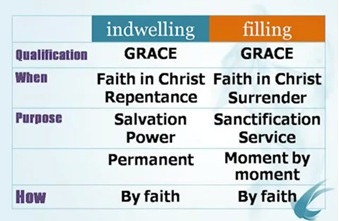
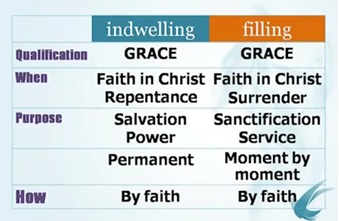
The Holy Spirit will never leave us, but the fullness of the Spirit must be renewed moment by moment as we yield ourselves to His control in faith. From the first step of salvation to the daily walk of sanctification, everything is by faith—from beginning to end.
1 CORINTHIANS 6:19 Or do you not know that your body is a temple of the Holy Spirit who is in you, whom you have from God, and that you are not your own? 20 For you have been bought with a price: therefore glorify God in your body.
The normal Christian life is a life that belongs wholly to God. We are no longer our own, because Jesus Christ paid the full price for our redemption through His death on the cross. What once belonged to sin and self now belongs to Him alone.
Because we have been purchased at such great cost, our lives have a new purpose: to glorify God. Every part of who we are—our bodies, choices, desires, and actions—is now meant to reflect His holiness and honor. This changes how we see ourselves and how we live each day.
Christianity, therefore, is not merely about external behavior or religious obligation, but about belonging to God in a personal and ongoing relationship. Our lives are meant to be visible testimonies that we are His, set apart for His glory.
1 CORINTHIANS 3:1 And I, brethren, could not speak to you as to spiritual men, but as to men of flesh, as to infants in Christ. 2 I gave you milk to drink, not solid food; for you were not yet able to receive it. Indeed, even now you are not yet able, 3 for you are still fleshly. For since there is jealousy and strife among you, are you not fleshly, and are you not walking like mere men?
Paul describes them as infants in Christ. As new believers, this was understandable at the beginning. Infants need milk, not solid food. But the problem is that they failed to grow. God expects growth in the Christian life. When there is no progress, something is wrong—spiritual stagnation is not normal Christianity.
Their jealousy and strife revealed that they were being governed by the flesh rather than by the Spirit. Though they had Christ, their behavior resembled that of unbelievers. They were walking “like mere men,” living as if nothing had changed.
This passage reminds us that while salvation makes us children of God instantly, maturity is meant to follow. A life continually dominated by the flesh is not God’s design. The normal Christian life is one of growth—moving from spiritual infancy toward Spirit-led maturity.
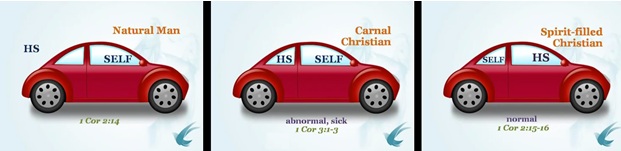
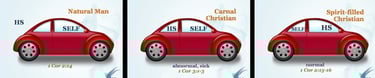
The natural man is the person who is in full control of his own life. He sits in the driver’s seat and decides the direction, priorities, and values of his life. The Holy Spirit is outside, not because God is unwilling to enter, but because the person has not yet come to know the Lord. Without Christ, the Spirit of God cannot dwell within, and life is governed entirely by human wisdom, desires, and strength.
The carnal Christian is someone who truly belongs to Christ, yet still insists on driving his own life. Jesus is present, but only as a passenger—invited to come along, but not allowed to direct the course. This believer is saved, but not surrendered. As a result, the flesh remains in control, producing conflict, frustration, and spiritual immaturity. This is not God’s design for the Christian life; it is an abnormal and unhealthy condition.
The Spirit-filled Christian represents the normal Christian life as God intended it. Here, the Holy Spirit occupies the driver’s seat, directing every area of life. The believer willingly yields control, trusting God’s guidance and power. In this life, Christ is not merely present but reigning, and the result is growth, obedience, peace, and spiritual fruit. This is the life of true freedom—living not by self-effort, but by the Spirit’s leading.
GALATIANS 5:16 But I say, walk by the Spirit, and you will not carry out the desire of the flesh. 17 For the flesh sets its desire against the Spirit, and the Spirit against the flesh; for these are in opposition to one another, so that you may not do the things that you please.
To walk by the Spirit means to live under the daily guidance and power of the Holy Spirit rather than relying on our own strength. This walk is continual, not momentary. Within every believer there is an ongoing conflict: the flesh pulls toward sin and self-rule, while the Spirit leads toward holiness and obedience. Because these two are opposed, the Christian life is marked by dependence—choosing submission to the Spirit instead of yielding to the flesh.
19 Now the deeds of the flesh are evident, which are: immorality, impurity, sensuality, 20 idolatry, sorcery, enmities, strife, jealousy, outbursts of anger, disputes, dissensions, factions, 21 envying, drunkenness, carousing, and things like these, of which I forewarn you, just as I have forewarned you, that those who practice such things will not inherit the kingdom of God. 22 But the fruit of the Spirit is love, joy, peace, patience, kindness, goodness, faithfulness, 23 gentleness, self-control; against such things there is no law... 25 If we live by the Spirit, let us also walk by the Spirit.
The deeds of the flesh—including immorality, jealousy, drunkenness, and outbursts of anger—reveal a life governed by sinful nature. These are not harmless traits but evidences of fleshly control. In contrast, the Holy Spirit produces fruit that reflects Christ’s character: love, joy, peace, patience, kindness, goodness, faithfulness, gentleness, and self-control.
The gospel does not merely forgive; it transforms. Salvation is by grace through faith, yet that grace actively changes a person’s direction. The presence of the Holy Spirit does not result in instant perfection, but it does produce a new pattern of life. Where the Spirit dwells, fruit follows.
Victory over the flesh does not come through self-effort but through surrender. Our responsibility is to walk by the Spirit—yielding to His leading in real, everyday moments. His responsibility is to produce the fruit. Each decision becomes a crossroads: react according to the flesh or respond under the Spirit’s control.
“If we live by the Spirit, let us also walk by the Spirit.” A Spirit-filled life is one where the Holy Spirit governs our responses, reshapes our character, and makes the life of Christ visible through us.
EPHESIANS 5:19 speaking to one another in psalms and hymns and spiritual songs, singing and making melody with your heart to the Lord;
A Spirit-filled life is marked by joy and worship that flow naturally from a heart indwelt by the Holy Spirit. This joy is not rooted in circumstances, possessions, or comfort, but in the unchanging presence of God. Because its source is the Lord Himself, it cannot be produced by human effort or taken away by hardship. When the Spirit fills a believer, praise overflows—both privately in the heart and corporately among God’s people. Worship becomes a genuine response, not a performance.
ACTS 13:52 And the disciples were continually filled with joy and with the Holy Spirit.
Joy is not an occasional experience for a select few believers; it is the normal fruit of a life governed by the Holy Spirit. Even in the face of opposition, the early disciples were continually filled with joy and with the Holy Spirit. This joy is deep, resilient, and enduring—rooted in God’s presence rather than changing circumstances. It is given by grace and sustained by the Spirit.
EPHESIANS 5:20 always giving thanks for all things in the name of our Lord Jesus Christ to God, even the Father; 21 and be subject to one another in the fear of Christ.
A thankful and humble spirit is another clear evidence of the Spirit’s control. Spirit-filled believers cultivate gratitude, trusting God’s sovereignty even in difficult situations. This gratitude does not deny hardship but rests in confidence that God is at work for His purposes. From this posture flows humility—expressed in mutual submission and reverence for Christ. When the Spirit governs the heart, pride gives way to love, and relationships are shaped by grace.
Ephesians 5 presents a picture of the Spirit-filled life in action. Joy expresses itself in worship, gratitude shapes the heart, and humility transforms relationships. Life in the Spirit is not lived in isolation; it is revealed in how believers respond to God and to one another, beginning in the heart and extending into every area of life.
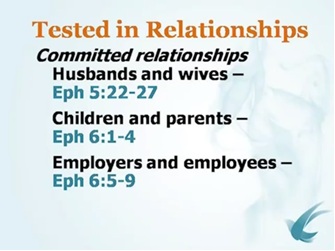
The command to be filled with the Spirit is most clearly tested. God calls us to live under the Spirit’s control—day by day, moment by moment—and that control is revealed in our closest and most demanding relationships.
The Spirit-filled life is first tested in the family. Husbands and wives, parents and children—these relationships expose whether we are truly yielding to the Spirit or merely relying on our own strength. Love, patience, respect, and self-control cannot be sustained by human effort alone; they require the ongoing work of the Holy Spirit.
Beyond the home, the Spirit-filled life is tested in committed and structured relationships—those involving responsibility, authority, and service. How we lead, how we submit, how we treat others, and how we respond under pressure all reveal who is in control of our lives.
The Christian life is indeed an amazing and joyful life, but it is not lived by self-effort. Its joy and power flow from being continually filled with the Spirit of God. When the Spirit governs us, ordinary relationships become places where Christ’s life is displayed, and everyday obedience becomes a testimony to God’s transforming grace.
ACTS 11:24 for he was a good man, and full of the Holy Spirit and of faith. And considerable numbers were brought to the Lord.
A Spirit-filled life is evident to others. People recognized Barnabas as a good man—not because of natural personality or moral effort, but because the character of Christ was visible in him. When the Holy Spirit fills a believer, Christ’s life is reflected in everyday conduct. Being full of the Spirit is inseparable from living by faith. Others could see faith at work in Barnabas—trust in God, confidence in His promises, and obedience in action. Faith expressed through a Spirit-controlled life becomes a powerful witness. The result is impact. Lives are drawn to Christ not merely by words, but by a life that radiates grace, truth, and love. The Spirit-filled life is both attractive and contagious. When Christ is clearly seen in a believer, God uses that life to bring many to Himself.
Prayer
Heavenly Father,
We come before You with grateful hearts, acknowledging that You are good and Your ways are perfect. Thank You for Your Word, which lovingly guides us—not to restrain us, but to lead us into true freedom, joy, and life.
Lord, You command us to be filled with Your Spirit, and we confess how easily we rely on our own strength. Forgive us for the times we allow other influences—habits, emotions, fears, or pride—to govern our hearts instead of yielding fully to You. Teach us to live moment by moment under the gentle, holy control of Your Spirit.
Fill us anew, O God. Let Your Spirit shape our thoughts, guide our choices, and rule our desires. May our lives reflect the joy that flows from Your presence—not a joy dependent on circumstances, but one rooted in who You are. Place a song of praise in our hearts, that we may worship You sincerely, both in private and among Your people.
Father, cultivate within us a spirit of gratitude. Help us to give thanks in all things, trusting Your sovereign hand even when the path is difficult. Guard our hearts from complaint and bitterness, and replace them with confidence in Your faithful purposes.
Teach us humility in our relationships. Help us to submit to one another out of reverence for Christ. In our homes, may Your Spirit produce love, patience, gentleness, and self-control. In our work and responsibilities, let integrity, respect, and grace be the evidence that You are in control of our lives.
Lord, we acknowledge that we cannot live the Christian life by self-effort. We need You—daily, constantly, desperately. Let Your Spirit govern us so that Christ may be seen in our ordinary moments, our closest relationships, and our everyday obedience.
We yield ourselves to You again today.
Be glorified in us, and through us, for the praise of Your glorious grace.
In the name of our Lord Jesus Christ,
Amen.
The content of this article is adapted from the source below:
Knowing God - Know the Holy Spirit Part 2

Get in touch for more insights.
Follow
Subscribe
info@themessageofgod.Some
123-456-7890
© 2025. All rights reserved.
By God’s grace, this website, The Message of God, was created to share His Word, encourage others in their faith, and lead people to a personal relationship with Jesus Christ. God has uniquely designed and equipped every believer to take part in His work, and this website is one small expression of that calling.
All glory, honor, and praise belong to God alone. I am deeply grateful to Christ’s Commission Fellowship (CCF)—God’s instrument in helping me know Jesus personally and grow in a deeper, more intimate relationship with Him. The messages shared here are inspired by past CCF sermons, which have greatly influenced my walk with the Lord.
The ultimate purpose of this website is to point people to Jesus, encourage them to follow Him wholeheartedly, and remind every reader that a life surrendered to Christ is a life filled with purpose, grace, and joy.