
Talent
Blog post description.
3/20/20132 min read
A talent is a God-given natural ability or skill that a person possesses from birth. It is part of God’s design and purpose for every individual, reflecting His creativity and wisdom. Talents are not random—they are gifts of God’s common grace, meaning He gives them to all people, whether believers or not. These abilities can include artistic creativity, musical skill, athletic ability, communication, leadership, organization, craftsmanship, problem-solving, or any other natural aptitude that allows a person to contribute meaningfully to society.
Spiritually speaking, a talent carries a deeper meaning: it represents stewardship. Everything we have—our intelligence, skills, time, and strength—belongs to God. He is the true owner; we are the caretakers. When we use our talents with humility and gratitude, we reflect God’s image and honor the purpose for which He created us.
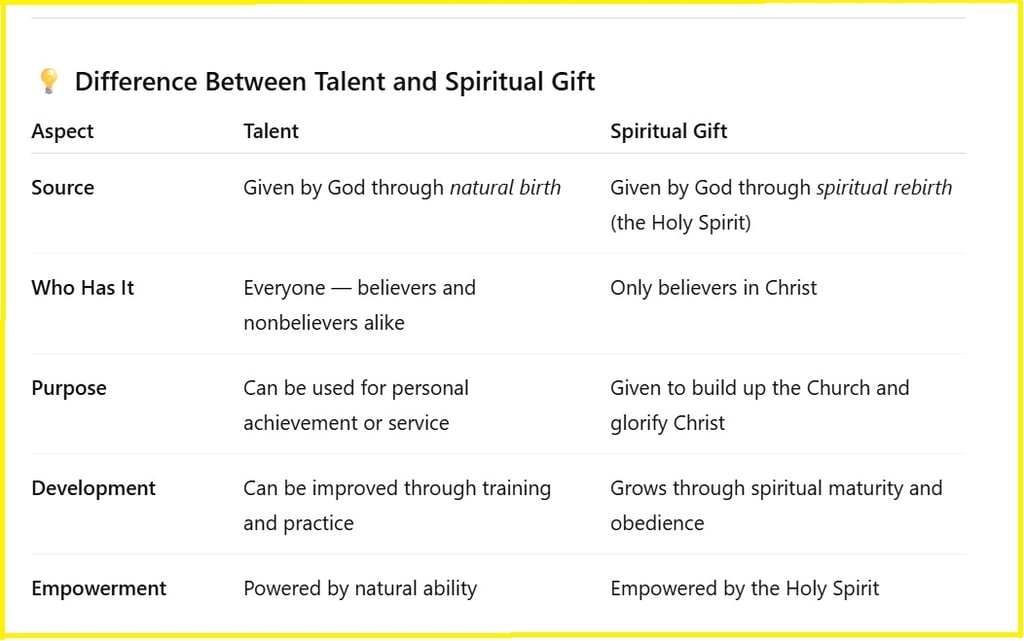
Both talents and gifts are meant to honor God — talents show His creativity and wisdom, while spiritual gifts reveal His power and grace at work in and through believers.
🌿 1. When a Talent Becomes a Spiritual Gift
A talent becomes a spiritual gift when it is dedicated to God and empowered by the Holy Spirit for the purpose of glorifying Christ and building up His Church.
For example:
A person who has a natural talent for singing may use it for personal fame or entertainment. But when that same person offers their voice to God — to lead others in worship and point hearts toward Christ — the Holy Spirit empowers that talent to become a spiritual gift for ministry.
Likewise, someone gifted in teaching, leadership, or writing may naturally possess those skills, but when they are used under the Spirit’s direction to strengthen and equip others in the faith, those abilities become instruments of divine grace.
🔥 2. When a Spiritual Gift Becomes Like a Talent
On the other hand, a spiritual gift can become like a mere talent when it is used apart from the Spirit’s guidance or for selfish reasons rather than for God’s glory.
For example:
Someone with the spiritual gift of teaching may start to rely on their own intelligence or eloquence instead of the Spirit’s wisdom.
A person with the gift of leadership may use it to control or seek recognition instead of serving humbly.
In those cases, what was meant to be a Spirit-empowered ministry can become just a human ability—still impressive, but lacking spiritual power and eternal impact.
Back to
Get in touch for more insights.
Follow
Subscribe
info@themessageofgod.Some
123-456-7890
© 2025. All rights reserved.
By God’s grace, this website, The Message of God, was created to share His Word, encourage others in their faith, and lead people to a personal relationship with Jesus Christ. God has uniquely designed and equipped every believer to take part in His work, and this website is one small expression of that calling.
All glory, honor, and praise belong to God alone. I am deeply grateful to Christ’s Commission Fellowship (CCF)—God’s instrument in helping me know Jesus personally and grow in a deeper, more intimate relationship with Him. The messages shared here are inspired by past CCF sermons, which have greatly influenced my walk with the Lord.
The ultimate purpose of this website is to point people to Jesus, encourage them to follow Him wholeheartedly, and remind every reader that a life surrendered to Christ is a life filled with purpose, grace, and joy.