
The Story of David
...and the Spirit of the Lord came mightily upon David from that day forward...
1 SAMUEL 16:13
4/13/201310 min read
God spoke to the prophet Samuel and said, “I want a new king. Go to the family of Jesse in Bethlehem, for I have chosen one of his sons to be king.”
When Jesse heard the news, he must have been filled with excitement and pride. One of his sons was going to be chosen by God! Jesse then presented his strongest, most promising sons before Samuel. Each one seemed impressive in appearance and stature.
6 When they entered, he looked at Eliab and thought, “Surely the Lord’s anointed is before Him.” 7 But the Lord said to Samuel, “Do not look at his appearance or at the height of his stature, because I have rejected him; for God sees not as man sees, for man looks at the outward appearance, but the Lord looks at the heart.” 8 Then Jesse called Abinadab and made him pass before Samuel. And he said, “The Lord has not chosen this one either.” 9 Next Jesse made Shammah pass by. And he said, “The Lord has not chosen this one either.” 10 Thus Jesse made seven of his sons pass before Samuel. But Samuel said to Jesse, “The Lord has not chosen these.”
One by one, Jesse’s older sons passed before Samuel, yet God rejected each of them. Even after all seven had been presented, none were chosen. God’s criteria are not the same as ours. What we often value — strength, appearance, or social prominence — does not determine God’s choice. Instead, God looks beyond the outward, examining the heart, character, and faithfulness of a person. It is the inner devotion to Him, not outward perfection, that qualifies someone for His calling.
11 And Samuel said to Jesse, “Are these all the children?” And he said, “There remains yet the youngest, and behold, he is tending the sheep.” Then Samuel said to Jesse, “Send and bring him; for we will not sit down until he comes here.”
David was not even considered by his own father and brothers. They did not see in him the potential to be king. Perhaps they thought he was too young, too ordinary, or simply not qualified. But God saw something in David that others could not see — a heart after His own heart.
12 So he sent and brought him in. Now he was ruddy, with beautiful eyes and a handsome appearance. And the Lord said, “Arise, anoint him; for this is he.” 13 Then Samuel took the horn of oil and anointed him in the midst of his brothers; and the Spirit of the Lord came mightily upon David from that day forward. And Samuel arose and went to Ramah.
The key to true transformation — to stepping into your God-given destiny — begins with the Spirit of God.
When David was anointed, the Spirit of the LORD came mightily upon him. That was the turning point of his life. From that moment on, God was at work in ways no one else could see.
Our future is not in the hands of people. It’s not controlled by our family, our status, or what others think of us. Our future is in the hands of God. So don’t be bitter or angry at those who overlook or underestimate you. Put your confidence in God. He alone determines your destiny and success.
After David’s anointing, God began to arrange everything. King Saul started to be emotionally and mentally tormented. At just the right time, someone in the palace mentioned David — a skillful musician. And so, David was brought to the king to play the harp and bring comfort to Saul’s troubled spirit.
Suddenly, David had two roles: a shepherd in the fields, and a musician in the palace.
God was training and positioning David step by step for his future calling. He didn’t become king overnight, but God was already moving behind the scenes.
Then, a crisis arose: the Philistines gathered for war against Israel. What looked like a problem was actually God’s setup for David’s promotion.
1 SAMUEL 16
2 Saul and the men of Israel were gathered and camped in the valley of Elah, and drew up in battle array to encounter the Philistines. 3 The Philistines stood on the mountain on one side while Israel stood on the mountain on the other side, with the valley between them. 4 Then a champion came out from the armies of the Philistines named Goliath, from Gath, whose height was six cubits and a span.
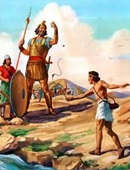
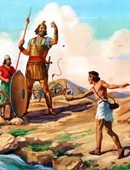
Goliath was over nine feet tall, a giant of a man, covered in armor, trained to destroy. Goliath began shouting and mocking the army of Israel. He cursed their God and challenged them to send a man to fight him in one-on-one combat. To the Israelites, Goliath seemed unbeatable — too big, too strong, too terrifying. But what they didn’t realize was this: no giant is bigger than God.
14 David was the youngest. Now the three oldest followed Saul, 15 but David went back and forth from Saul to tend his father’s flock at Bethlehem.16 The Philistine came forward morning and evening for forty days and took his stand.
For forty long days, Goliath stepped out morning and evening to mock Israel, defy the living God, and strike fear into Saul’s army. Day after day, nothing changed. The same threats were heard, the same fear gripped the people, and the same silence followed. One hill was filled with arrogance; the other was filled with fear. And in between stood a battlefield waiting for a breakthrough.
Yet God was not absent, and He was not late. He was waiting for the appointed time. On the fortieth day—a number often connected with testing and preparation—God moved. David arrived, not as a soldier, but as an obedient son and faithful shepherd, simply carrying food to his brothers.
David’s victory did not begin on the battlefield; it began in the fields of Bethlehem, where he faithfully tended sheep and learned to trust God in the ordinary. While others were paralyzed by fear, David saw the situation through eyes of faith. What the army saw as a giant, David saw as a challenge to the honor of God.
Sometimes God uses ordinary obedience to position us for extraordinary moments. When the time is right, He brings the prepared servant to the waiting battlefield—and His power is revealed.
17 Then Jesse said to David his son, “Take now for your brothers an ephah of this roasted grain and these ten loaves and run to the camp to your brothers. 18 … look into the welfare of your brothers, and bring back news of them.
David had already been anointed as the future king of Israel, but when his father gave him a simple task — to bring food and check on his brothers — David obeyed without question. He didn’t say, “I’m too important for this.” He didn’t complain or boast about his destiny. Instead, David showed the heart of a true servant. Before God raises a person to lead, He first teaches them to serve faithfully in the small things.
20 So David arose early in the morning and left the flock with a keeper and took the supplies and went as Jesse had commanded him. And he came to the circle of the camp while the army was going out in battle array shouting the war cry... 24 When all the men of Israel saw the man, they fled from him and were greatly afraid.
David obeyed promptly. He arrived at the battlefield just as the soldiers were shouting their war cry. On the outside, it looked like they were ready to fight. But when Goliath appeared, the truth came out: the soldiers ran in fear.
For forty days, no one volunteered. Not a single soldier was willing to face the giant. Even King Saul — the tallest man in Israel — was afraid. Their voices shouted war, but their hearts were filled with fear.
26 Then David spoke to the men who were standing by him, saying, “What will be done for the man who kills this Philistine and takes away the reproach from Israel? For who is this uncircumcised Philistine, that he should taunt the armies of the living God?”
While everyone else was terrified, David saw the situation through the eyes of faith. The same Goliath that paralyzed the Israelite army stirred something different in David’s heart because the Spirit of God was stirring David. When the Holy Spirit is in you, you will not react like the world does. Others saw a giant while David saw God in the battlefield. Others saw impossible while David saw God’s victory.
To David, the real issue wasn’t Goliath’s strength — it was that Goliath was defying God. David wasn’t intimidated because he knew the battle belonged to the Lord.
28 Now Eliab his oldest brother heard when he spoke to the men; and Eliab’s anger burned against David and he said, “Why have you come down? And with whom have you left those few sheep in the wilderness? I know your insolence and the wickedness of your heart; for you have come down in order to see the battle.”
David’s own brother, Eliab, reacted with anger and accusation. Instead of supporting him, Eliab questioned his motives and insulted his character. He belittled David by reminding him of the “few sheep” he was tending, as if to say, “You’re just a shepherd boy. David was falsely accused and misunderstood, yet notice his response: He did not argue, He did not explain or defend himself, He did not make his brother the enemy. David knew — this was not his fight. The real battle was with Goliath, not with his brother. He refused to be distracted by personal offenses.
29 But David said, “What have I done now? Was it not just a question?” 30 Then he turned away from him to another and said the same thing; and the people answered the same thing as before.
David didn’t let his brother’s hurtful words distract him or pull him into a useless argument. He turned away and went on with what mattered. David didn’t take it personally. He didn’t try to justify himself or prove his innocence. He knew God was his defender, not people.
Because David didn’t get stuck in personal offense, God opened the next door. Word spread quickly in the camp: Someone is willing to face Goliath! King Saul, who had been waiting forty days for a volunteer, was excited. Finally, there was hope. So he called for David.
When David stood before Saul, the king did not even recognize him. To Saul, he was just a young boy — not a warrior. But what Saul couldn’t see was that God’s Spirit was already at work in David.
33 Then Saul said to David, “You are not able to go against this Philistine to fight with him; for you are but a youth while he has been a warrior from his youth.”
David felt God urging him to face Goliath. But even the king, Saul, doubted his ability and discouraged him. This reminds us that when God calls us to do something, there will always be other voices that say, “You can’t.” Not everyone will understand God’s plan for your life. When you know what God has placed in your heart, stand firm in faith. People may see your limitations, but God sees His power working through you.
And the key to knowing God’s voice is growing in our love for Him. If we love God, we will want to know Him more. If we want to know Him more, we will read His Word. Just as we’re excited to read a love letter from someone dear to us, we should be excited to read the Bible—God’s love letter to us.
37 And David said, “The Lord who delivered me from the paw of the lion and from the paw of the bear, He will deliver me from the hand of this Philistine.” And Saul said to David, “Go, and may the Lord be with you.”
David’s confidence did not come from his strength or experience as a soldier—it came from his intimacy with God. He remembered how God had been faithful to him in the past, and that gave him courage to face the present battle. Past encounters with God build present faith. David had experienced God’s power and protection before, and he trusted that the same God who delivered him from the lion and the bear would also deliver him from Goliath. Intimacy with God leads to confidence in God.
45 Then David said to the Philistine, “You come to me with a sword, a spear, and a javelin, but I come to you in the name of the Lord of hosts, the God of the armies of Israel, whom you have taunted. 46 This day the Lord will deliver you up into my hands, and I will strike you down and remove your head from you… that all the earth may know that there is a God in Israel,
David faced a giant without armor, sword, or spear—armed only with faith in the living God. His confidence was not in human strength but in the power and authority of God’s name. Intimately walking with the Lord and filled with His Spirit, David understood that the battle belonged to God, not to man. He was not driven by pride or personal glory; his passion was to honor God. His bold declaration to Goliath reflected faith in God and a desire for the world to see that the God of Israel fights for His people. This focus on God’s glory gave him courage, boldness, and unwavering confidence—his battle was for God, not for himself.
47 and that all this assembly may know that the Lord does not deliver by sword or by spear; for the battle is the Lord’s and He will give you into our hands.”
David understood a powerful truth: the outcome of every battle rests in God’s hands, not in human strength or weapons. His confidence was not in skill, numbers, or resources, but in the Lord who fights for His people. David wanted everyone to know—not just Goliath, but the entire assembly of Israel—that victory belongs to the Lord. His focus was on who God is, not what he could do. The key to having this kind of unshakable faith is to know God personally: Learn about God — through His Word, Obey His voice — practicing the “obey now” principle strengthens your trust, Walk with Him daily — as you experience His faithfulness, your confidence will grow.
48 … David ran quickly toward the battle line to meet the Philistine.
When David was certain that God would give the victory, he didn’t hesitate. He didn’t delay. He ran toward the battle. This is the picture of faith in action — not just believing in God’s power, but stepping out boldly to obey Him.
Many people stay in their comfort zone, waiting for the “perfect moment.” But David shows us that when God has made His will clear, the right time is now. Delayed obedience is often disobedience. David didn’t wait for Goliath to come closer; he moved forward because his confidence was in the Lord.
49 And David put his hand into his bag and took from it a stone and slung it, and struck the Philistine on his forehead. And the stone sank into his forehead, so that he fell on his face to the ground.
This moment marks the climactic victory of faith over fear. David, a young shepherd boy, defeated a seasoned warrior not with conventional weapons but with a simple stone and sling, tools familiar from his daily life tending sheep. The victory was miraculous not because of the weapon, but because of the God behind the hand that threw it.
God works through the ordinary – David’s sling and stone were ordinary tools, yet God used them to accomplish an extraordinary purpose.
Faith over technology or strength – Human weapons and military training could not guarantee victory; God’s power did.
Obedience yields results – David trusted God’s plan and obeyed, stepping forward when others were paralyzed by fear.
God’s glory is revealed – This victory demonstrated that the battle belongs to the Lord, and that He fights for His people.
The underestimated can triumph – David, overlooked by his family and army, became the instrument of God’s miraculous deliverance.
1 SAMUEL 17
Back to
Get in touch for more insights.
Follow
Subscribe
info@themessageofgod.Some
123-456-7890
© 2025. All rights reserved.
By God’s grace, this website, The Message of God, was created to share His Word, encourage others in their faith, and lead people to a personal relationship with Jesus Christ. God has uniquely designed and equipped every believer to take part in His work, and this website is one small expression of that calling.
All glory, honor, and praise belong to God alone. I am deeply grateful to Christ’s Commission Fellowship (CCF)—God’s instrument in helping me know Jesus personally and grow in a deeper, more intimate relationship with Him. The messages shared here are inspired by past CCF sermons, which have greatly influenced my walk with the Lord.
The ultimate purpose of this website is to point people to Jesus, encourage them to follow Him wholeheartedly, and remind every reader that a life surrendered to Christ is a life filled with purpose, grace, and joy.