
Wait on God
Be strong and let your heart take courage, All you who hope in the Lord.
PSALM 31:24
11/16/201411 min read
Waiting on God is not passive resignation but active trust. Throughout the life of Joseph, God teaches us that waiting is part of His process of shaping our character, deepening our faith, and preparing us for His purpose.
PRAYER
Heavenly Father,
Thank You for reminding us that waiting on You is not passive resignation but active trust. Thank You for for showing us that even in seasons of delay, suffering, disappointment, and uncertainty, You are always at work behind the scenes.
Lord, teach us to wait on You with faith and confidence. Help us to rest in You and not become anxious, bitter, or impatient when things do not happen according to our timing. Guard our hearts from comparing ourselves with others or depending too much on people who may fail us. Remind us that You never forget Your children and that Your timing is always perfect.
Father, shape our character while we wait. Deepen our faith, strengthen our hearts, and draw us closer to You. Help us remain faithful in every situation — whether in times of blessing, hardship, promotion, or hiddenness. Teach us to continue serving others, honoring You, and giving You glory even when we do not yet see the fulfillment of Your plans.
Lord, help us trust that every trial has a purpose and every delay is part of Your preparation. When we feel weary emotionally and spiritually, renew our strength as we focus on You. Teach us to wait expectantly, believing that You are working all things together for good.
May our hope rest not in circumstances or people, but in You alone — our Rock, our Salvation, and our Stronghold.
In Jesus’ name we pray,
Amen.
The different Hebrew words for “wait” reveal that biblical waiting is not passive inactivity, but a life of resting in God, depending on Him, persevering through trials, and hoping expectantly in His promises. True waiting is centered not on circumstances, answers, or outcomes, but on God Himself.
PSALM 37:7 Rest in the Lord and wait patiently for Him; Do not fret because of him who prospers in his way, Because of the man who carries out wicked schemes.
The Hebrew word DAMAN in Psalm 37:7 emphasizes resting quietly before God. Waiting begins with surrender. Instead of becoming anxious because evil people seem to prosper, believers are called to be still and trust that God remains in control. Waiting on the Lord means refusing to be consumed by comparison, jealousy, or agitation. God’s people are not to imitate the world’s shortcuts because faith trusts God’s timing over visible success.
ISAIAH 40:31 Yet those who wait for the Lord Will gain new strength; They will mount up with wings like eagles, They will run and not get tired, They will walk and not become weary.
The word QAVAH in Isaiah 40:31 carries the idea of being bound together like strands of a rope. Waiting on God is relational. It is drawing so close to Him that His strength becomes our strength. Many people become emotionally exhausted because they carry burdens alone. But those who wait on the Lord learn to depend on Him daily. Their focus shifts from circumstances to God Himself, and through that dependence they receive renewed strength to continue walking faithfully.
PSALM 106:13 They quickly forgot His works; They did not wait for His counsel,
The word CHAKAH in Psalm 106:13 teaches perseverance in waiting. Israel quickly forgot God’s works because they refused to wait for His counsel. Impatience often leads people to act independently of God. Waiting requires tarrying before Him long enough to seek His wisdom rather than rushing ahead with human solutions. Faith does not demand immediate answers; it trusts that God knows the right time and way.
YACHAL – hope, wait expectantly
PSALM 31:24 Be strong and let your heart take courage, All you who hope in the Lord.
The word YACHAL in Psalm 31:24 describes hopeful expectation. Biblical waiting is not gloomy or hopeless. It is confident anticipation that God will act according to His goodness and promises. Those who hope in the Lord strengthen their hearts because their expectation rests not in circumstances or people, but in God’s faithfulness.
GENESIS 40
1 Then it came about after these things, the cupbearer and the baker for the king of Egypt offended their lord, the king of Egypt. 2 Pharaoh was furious with his two officials, the chief cupbearer and the chief baker. 3 So he put them in confinement in the house of the captain of the bodyguard, in the jail, the same place where Joseph was imprisoned. 4 The captain of the bodyguard put Joseph in charge of them, and he took care of them; and they were in confinement for some time.
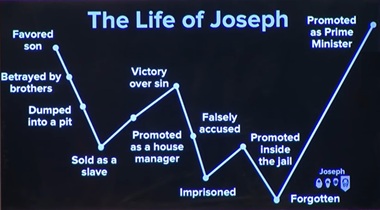
Joseph’s life had been marked by suffering: betrayed by his brothers, sold into slavery, falsely accused, and imprisoned. Yet every painful season became part of God’s preparation. Even inside prison, Joseph continued serving faithfully. God positioned him there to meet Pharaoh’s officials, showing that there are no accidents in the lives of God’s people. Waiting on God does not mean inactivity; it means remaining faithful wherever God places you.
5 Then the cupbearer and the baker for the king of Egypt, who were confined in jail, both had a dream the same night, each man with his own dream and each dream with its own interpretation. 6 When Joseph came to them in the morning and observed them, behold, they were dejected. 7 He asked Pharaoh’s officials who were with him in confinement in his master’s house, “Why are your faces so sad today?” 8 Then they said to him, “We have had a dream and there is no one to interpret it.” Then Joseph said to them, “Do not interpretations belong to God? Tell it to me, please.”
When Joseph noticed the sadness of the cupbearer and baker in Genesis 40:5–8, he demonstrated spiritual maturity. Though he himself had every reason to despair, he remained sensitive to the needs of others. Waiting on the Lord had not made him bitter; it had made him compassionate. Joseph’s confidence that interpretations belong to God revealed his intimacy with the Lord. His emotional stability came not from favorable circumstances but from his relationship with God. True waiting produces servants who continue caring for others even while enduring hardship.
12 Then Joseph said to him, “This is the interpretation of it: the three branches are three days; 13 within three more days Pharaoh will lift up your head and restore you to your office; and you will put Pharaoh’s cup into his hand according to your former custom when you were his cupbearer. 14 Only keep me in mind when it goes well with you, and please do me a kindness by mentioning me to Pharaoh and get me out of this house. 15 For I was in fact kidnapped from the land of the Hebrews, and even here I have done nothing that they should have put me into the dungeon.” 16 When the chief baker saw that he had interpreted favorably, he said to Joseph, “I also saw in my dream, and behold, there were three baskets of white bread on my head; 17 and in the top basket there were some of all sorts of baked food for Pharaoh, and the birds were eating them out of the basket on my head.” 18 Then Joseph answered and said, “This is its interpretation: the three baskets are three days; 19 within three more days Pharaoh will lift up your head from you and will hang you on a tree, and the birds will eat your flesh off you.”
Joseph faithfully interpreted both the favorable and unfavorable dreams. He spoke truthfully because faithfulness to God matters more than pleasing people. Joseph also asked the cupbearer to remember him before Pharaoh. This shows that waiting on God does not forbid responsible action. Trusting God does not eliminate wise effort; rather, believers act faithfully while leaving the results in God’s hands.
20 Thus it came about on the third day, which was Pharaoh’s birthday, that he made a feast for all his servants; and he lifted up the head of the chief cupbearer and the head of the chief baker among his servants. 21 He restored the chief cupbearer to his office, and he put the cup into Pharaoh’s hand; 22 but he hanged the chief baker, just as Joseph had interpreted to them. 23 Yet the chief cupbearer did not remember Joseph, but forgot him.
One of the painful realities of waiting is human disappointment. The cupbearer forgot Joseph for two full years. Joseph learned that people may fail, forget, or disappoint, but God never does. Often believers place their security in human relationships, opportunities, or recognition. God sometimes allows disappointment so that trust will rest fully in Him alone. What seemed like neglect was actually divine timing.
PSALM 62:1 My soul waits in silence for God only; From Him is my salvation. 2 He only is my rock and my salvation, My stronghold; I shall not be greatly shaken.
The soul waits silently for God alone. God Himself is the believer’s salvation, rock, and stronghold. Waiting becomes possible when faith is anchored in the character of God rather than in changing circumstances or unreliable people.
LAMENTATIONS 3:25 The Lord is good to those who wait for Him, To the person who seeks Him.
Waiting involves seeking God. The Lord is good to those who wait for Him because waiting draws people into deeper fellowship with Him. The greatest reward of waiting is not merely answered prayer but greater intimacy with God Himself.
GENESIS 41
PSALM 105:17 He sent a man before them, Joseph, who was sold as a slave. 18 They afflicted his feet with fetters, He himself was laid in irons; 19 Until the time that his word came to pass, The word of the Lord tested him. 20 The king sent and released him, The ruler of peoples, and set him free. 21 He made him lord of his house And ruler over all his possessions,
God sent Joseph ahead to preserve lives, but before promotion came testing. The Word of the Lord tested Joseph’s character until the appointed time arrived. God was not merely preparing Joseph for power; He was preparing him to handle power with humility and dependence upon God.
PSALM 75:6 For not from the east, nor from the west, Nor from the desert comes exaltation; 7 But God is the Judge; He puts down one and exalts another.
Exaltation comes from God alone. He raises up and brings down according to His purposes. Waiting on God therefore means trusting His process, His timing, and His ways.
GENESIS 41:15 Pharaoh said to Joseph, “I have had a dream, but no one can interpret it; and I have heard it said about you, that when you hear a dream you can interpret it.” 16 Joseph then answered Pharaoh, saying, “It is not in me; God will give Pharaoh a favorable answer.”
Joseph's response revealed the transformation produced through years of waiting. Joseph no longer sought self-promotion. Instead, he immediately gave glory to God, acknowledging that interpretation belonged to Him. Waiting on God teaches humility because faithful waiting removes the need to manipulate circumstances or grasp for recognition.
GENESIS 41:25 Now Joseph said to Pharaoh, “Pharaoh’s dreams are one and the same; God has told to Pharaoh what He is about to do. 26 The seven good cows are seven years; and the seven good ears are seven years; the dreams are one and the same. 27 The seven lean and ugly cows that came up after them are seven years, and the seven thin ears scorched by the east wind will be seven years of famine. 28 It is as I have spoken to Pharaoh: God has shown to Pharaoh what He is about to do. 29 Behold, seven years of great abundance are coming in all the land of Egypt; 30 and after them seven years of famine will come, and all the abundance will be forgotten in the land of Egypt, and the famine will ravage the land. 31 So the abundance will be unknown in the land because of that subsequent famine; for it will be very severe. 32 Now as for the repeating of the dream to Pharaoh twice, it means that the matter is determined by God, and God will quickly bring it about.
As Joseph interpreted Pharaoh’s dreams, his God-centered perspective became unmistakable. Again and again he pointed Pharaoh to what God was about to do. Joseph understood that history belongs to God. A person who waits on the Lord learns to see life through God’s sovereignty rather than through human ability.
GENESIS 41:37 Now the proposal seemed good to Pharaoh and to all his servants. 38 Then Pharaoh said to his servants, “Can we find a man like this, in whom is a divine spirit?” 39 So Pharaoh said to Joseph, “Since God has informed you of all this, there is no one so discerning and wise as you are. 40 You shall be over my house, and according to your command all my people shall do homage; only in the throne I will be greater than you.” 41 Pharaoh said to Joseph, “See, I have set you over all the land of Egypt.” 42 Then Pharaoh took off his signet ring from his hand and put it on Joseph’s hand, and clothed him in garments of fine linen and put the gold necklace around his neck. 43 He had him ride in his second chariot; and they proclaimed before him, “Bow the knee!” And he set him over all the land of Egypt. 44 Moreover, Pharaoh said to Joseph, “Though I am Pharaoh, yet without your permission no one shall raise his hand or foot in all the land of Egypt.”... 46 Now Joseph was thirty years old when he stood before Pharaoh, king of Egypt…
God exalted Joseph from prisoner to ruler over Egypt. The thirteen years of suffering were not wasted years. Every betrayal, false accusation, delay, and disappointment formed part of God’s preparation. Joseph’s trials produced wisdom, humility, perseverance, and dependence on God. Promotion came not from human effort but from God Himself.
1 Now it happened at the end of two full years that Pharaoh had a dream, and behold, he was standing by the Nile... 8 Now in the morning his spirit was troubled, so he sent and called for all the magicians of Egypt, and all its wise men. And Pharaoh told them his dreams, but there was no one who could interpret them to Pharaoh. 9 Then the chief cupbearer spoke to Pharaoh, saying, “I would make mention today of my own offenses... 12 Now a Hebrew youth was with us there, a servant of the captain of the bodyguard, and we related them to him, and he interpreted our dreams for us. To each one he interpreted according to his own dream. 13 And just as he interpreted for us, so it happened; he restored me in my office, but he hanged him.” 14 Then Pharaoh sent and called for Joseph, and they hurriedly brought him out of the dungeon; and when he had shaved himself and changed his clothes, he came to Pharaoh.
God’s perfect timing finally became visible. Pharaoh’s troubling dreams created the exact situation needed for Joseph to be remembered. God used the inability of Egypt’s wise men to reveal Joseph as the man prepared by God. What appeared to be delay was actually preparation. God had been arranging events far beyond Joseph’s understanding. The cupbearer’s restored memory, Pharaoh’s dreams, and Joseph’s sudden release from prison all happened according to divine timing.
PRAYER
Heavenly Father,
Thank You for teaching us that waiting on You is not wasted time, but a season of growth, preparation, and deeper intimacy with You. Thank You for reminding us through Your Word and through the life of Joseph that You are always at work, even when we cannot yet see Your plans unfolding.
Lord, help us to wait on You with hearts that are full of faith, peace, and hope. Teach us to rest in You instead of becoming anxious, to depend on Your strength instead of our own, and to persevere even in seasons of delay and disappointment. Keep us from putting our trust in people or circumstances, and help us fix our eyes on You alone.
Father, shape our character while we wait. Use every trial, every delay, and every difficulty to make us more faithful, humble, and Christlike. Like Joseph, may we continue serving others, honoring You, and giving You glory wherever You place us.
Help us remember that Your timing is always perfect and that Your plans are always good. Teach us to trust that You never forget Your children and that You are preparing us for Your purpose in Your perfect way.
May our lives always point back to You, for You alone are our hope, our strength, and our salvation.
In Jesus’ name we pray,
Amen.
The content of this article is adapted from the source below:

Blessed to Bless - Wait Expectantly
Get in touch for more insights.
Follow
Subscribe
info@themessageofgod.Some
123-456-7890
© 2025. All rights reserved.
By God’s grace, this website, The Message of God, was created to share His Word, encourage others in their faith, and lead people to a personal relationship with Jesus Christ. God has uniquely designed and equipped every believer to take part in His work, and this website is one small expression of that calling.
All glory, honor, and praise belong to God alone. I am deeply grateful to Christ’s Commission Fellowship (CCF)—God’s instrument in helping me know Jesus personally and grow in a deeper, more intimate relationship with Him. The messages shared here are inspired by past CCF sermons, which have greatly influenced my walk with the Lord.
The ultimate purpose of this website is to point people to Jesus, encourage them to follow Him wholeheartedly, and remind every reader that a life surrendered to Christ is a life filled with purpose, grace, and joy.